

BitMine Immersion Technologies (NYSE: BMNR), chaired by Tom Lee, has rapidly positioned itself as one of the most closely watched public companies in the Ethereum ecosystem. Unlike many crypto firms tBitMine Immersion Technologies (NYSE: BMNR), chaired by Tom Lee, has rapidly positioned itself as one of the most closely watched public companies in the Ethereum ecosystem. Unlike many crypto firms t
Why BitMine’s 98% Revenue From Staking May Be Both Its Biggest Strength and Greatest Constraint

BitMine Immersion Technologies (NYSE: BMNR), chaired by Tom Lee, has rapidly positioned itself as one of the most closely watched public companies in the Ethereum ecosystem. Unlike many crypto firms that generate revenue through a mix of mining, trading, custody, or software services, BitMine has built its business around a single core activity: Ethereum staking.
According to the company’s 10-Q filing for the fiscal quarter ended May 31, 2026, BitMine generated $46.5 million in total revenue, of which $45.7 million (98.3%) came from staking and validator operations. Bitcoin self-mining contributed just $624,000 and consulting $168,000. A year earlier, for the quarter ended May 31, 2025, total revenue was only about $2.05 million, mostly from machine leasing, underscoring how completely the company has pivoted since launching its institutional staking platform in March 2026.
At first glance, this concentration looks like operational excellence: staking provides recurring income while reinforcing Ethereum’s network security. But the same strategy that made BitMine a leader in institutional staking also exposes it to distinct operational, financial, and strategic risks tied to a decade-long management agreement and a balance sheet dominated by ETH.
1.BitMine Has Built a Pure-Play Ethereum Staking Business
BitMine’s model is straightforward: it earns the overwhelming majority of its income operating Ethereum validators and collecting staking rewards through its platform, MAVAN, in which BitMine holds a 98% interest (Ethereum Tower LLC holds the remaining 2%).
As of May 31, 2026, BitMine held 5,416,945 ETH (plus 203 BTC), valued at roughly $10.86 billion, with about 4.7 million ETH (87%) actively staked following a June 1 update. Cash on hand stood at $340.3 million, with working capital of $433.1 million. Lee has forecast that annualized staking revenue could reach $284 million once the full treasury is deployed.
Staking income is generally more predictable than trading since it depends on validator uptime and network participation rather than short-term price speculation. For investors seeking indirect Ethereum exposure through public equities, BitMine’s business performance closely mirrors the economics of staking itself rather than broader crypto-market swings.
2.The Strength of Revenue Concentration Can Also Become a Weakness
Generating over 98% of revenue from staking is also a concentration risk. Most successful public companies diversify; BitMine has deliberately chosen not to. If staking yields decline, due to rising validator participation, protocol upgrades, or reduced network activity, revenue could come under pressure almost immediately, since there is no other segment to absorb the impact. Validator downtime, infrastructure failures, cybersecurity incidents, or slashing events pose the same direct threat.
More significantly, BitMine’s massive ETH holdings expose reported earnings to mark-to-market accounting swings on a scale that dwarfs operations. The company reported a net loss of $9.1 billion for the nine months ended May 31, 2026 (versus roughly $56.9 million in staking revenue and $59.9 million in total revenue over that period), and a quarterly net loss of $82.2 million, compared with just $480,000 a year earlier. A healthy operating business does not guarantee stable accounting profits when digital assets dominate the balance sheet, and the market appears to be pricing that in: BMNR shares have fallen roughly 59% over the past twelve months, recently trading near $16.29.
3.The 10-Year Ethereum Tower Agreement Limits Strategic Flexibility
BitMine’s validator operations depend on a management services agreement with Ethereum Tower, effective March 24, 2026, covering strategic planning, custody, and day-to-day infrastructure work, with BitMine’s subsidiary retaining formal control and reserved powers.
The agreement runs an initial 10-year term, and exiting early is not simple. If BitMine terminates without qualifying cause, Ethereum Tower can retain its 2% MAVAN stake and elect either continuing revenue participation or a formula-based payment tied to the remaining contract period, creating meaningful switching costs.
The arrangement is also expensive. BitMine recorded $12.8 million in quarterly expenses under the agreement, about 28% of that quarter’s staking revenue, with cumulative costs of $37.5 million over the first nine months of the fiscal year. The company expects annual costs of $40–50 million, based on a tiered fee tied to assets under management, a cost structure that will scale as the treasury grows, narrowing the margin between gross staking yield and what ultimately reaches shareholders.
4.BitMine’s Future Is Closely Tied to Ethereum’s Success
BitMine’s future is inseparable from Ethereum’s. Continued adoption through DeFi, tokenization, institutional blockchain use, and real-world asset (RWA) initiatives could strengthen both its balance sheet and recurring staking income.
Conversely, prolonged ETH price weakness, falling staking yields, adverse regulatory changes for institutional staking, or unexpected protocol developments could have an outsized impact, given how little revenue diversification exists to cushion the blow.
BitMine has effectively become a publicly traded proxy for Ethereum’s Proof-of-Stake economy. Investors are buying exposure to Ethereum’s long-term economics as much as to a company. That’s attractive for those bullish on Ethereum, but it requires comfort with concentrated exposure that most diversified companies don’t carry.
5.What Investors Should Watch Going Forward
Investors should monitor several key metrics each quarter:
Staking revenue as a share of total revenue (currently 98.3%, up from 95% over the trailing nine months).
ETH staking ratio, currently 87% of the company’s 5.4 million ETH holdings, versus BitMine’s long-term goal of acquiring 5% of Ethereum’s total supply.
Ethereum Tower’s management fee as a percentage of staking revenue (28% in the latest quarter).
The gap between staking revenue and net income, since a $56.9 million operating result alongside a $9.1 billion nine-month loss illustrates how significantly accounting treatment of digital assets influences reported earnings.
Investors should also pay close attention to any amendments to the Ethereum Tower agreement, changes in ETH prices, and validator performance metrics, as each could materially affect BitMine’s outlook.
Conclusion
BitMine’s 98.3% staking-revenue share, generated from $46.5 million in quarterly revenue alongside 5.4 million ETH worth approximately $10.86 billion, demonstrates the earning power of a large-scale Ethereum validator business and makes the company one of the clearest public-market proxies for Ethereum’s Proof-of-Stake economy.
Yet those same figures—a management fee equal to roughly 28% of quarterly staking revenue under a contract that can run for up to ten years, and a $9.1 billion nine-month net loss driven largely by ETH’s market value rather than operations, highlight the trade-offs of such a concentrated strategy.
If Ethereum’s network and price continue to strengthen, BitMine stands to be one of the biggest beneficiaries. If staking economics weaken or ETH prices remain under pressure, however, the company’s greatest competitive advantage could also become its greatest constraint.
Disclaimer:This content is for educational and reference purposes only and does not constitute any investment advice. Digital asset investments carry high risk. Please evaluate carefully and assume full responsibility for your own decisions.
市場機遇
4實時價格 (4)
--
----
USD
4 (4) 實時價格圖表
描述:幣圈脈動基於 AI 技術與公開信息,第一時間呈現最熱代幣趨勢。如果想了解更多專業解讀與深度分析,請訪問新手學院。
本頁面分享的文章均源自公開平台,僅供參考。該內容不代表 MEXC 的立場或觀點。所有版權歸 Mubashir 所有。如果您認為任何內容侵犯了第三方的權益,請聯絡 service@support.mexc.com 以便及時刪除。 MEXC 不保證任何內容的準確性、完整性或及時性,且不對基於所提供信息而採取的任何行動負責。本內容不構成財務、法律或其他專業建議,亦不應被解釋為 MEXC 的推薦或認可。如需專家見解和深入分析,請造訪 MEXC 學院。
學習更多 4 知識
查看更多
如何在 MEXC 上購買 OKLOON:分步指南
摘要 OKLOON 是一款 Ondo 代幣化產品,旨在提供與 Oklo Inc.(NYSE: OKLO) 相關聯的經濟敞口。 MEXC 目前提供專屬的: OKLOON/USDT 現貨市場 MEXC 市場頁面將 OKLOON 標識為對應的標的公司奧克洛公司。 基本購買流程為: 登入 MEXC ↓ 查看資格 ↓ 準備 USDT ↓ 打開 OKLOON/USDT ↓ 驗證產品 ↓ 查看 OKLO 與 O
2026/08/18
如何在 MEXC 上將 USDT 閃兌為 OKLOON:Oklo 現貨 閃兌指南
摘要 OKLOON 是一種 Ondo 代幣化產品,旨在提供與 Oklo Inc.(NYSE: OKLO) 掛鉤的經濟敞口。 MEXC 已於 2026 年 3 月 13 日 10:00 UTC 正式將 OKLOON 新增至其 閃兌 服務。MEXC 將閃兌描述為一項簡化的兌換服務,無需另收交易手續費、可即時兌換,並提供報價固定的匯率,無需使用者手動在訂單簿上進行交易。 符合資格的用戶可存取: 在 ME
2026/08/18
Oklo 股票在 2026 年值得買入嗎?看多情境、看空情境與關鍵催化劑
摘要 問題 “OKLO 股票值得買入嗎?” 最終取決於投資者是否相信 Oklo 能夠將其異常強勁的核能開發管線,快速轉化為可營運資產,並且速度足以支撐其估值與未來資本需求。 牛市情境在 2026 年期間透過以下方式得到強化: Meta 的 1.2 GW 俄亥俄協議; Aurora-INL 監管進展; 中樞 HALEU 規劃; 格羅夫斯 啟動授權; 約 $3.0 十億的第二季流動性。 熊市情境同樣重
2026/08/18
4 最新動態
查看更多
西班牙對比利時比分預測:預期結果、勝率走向與比賽前景
2026/07/08
三星第二季獲利飆升19倍,但股價下跌:為何AI記憶體股面臨更高門檻
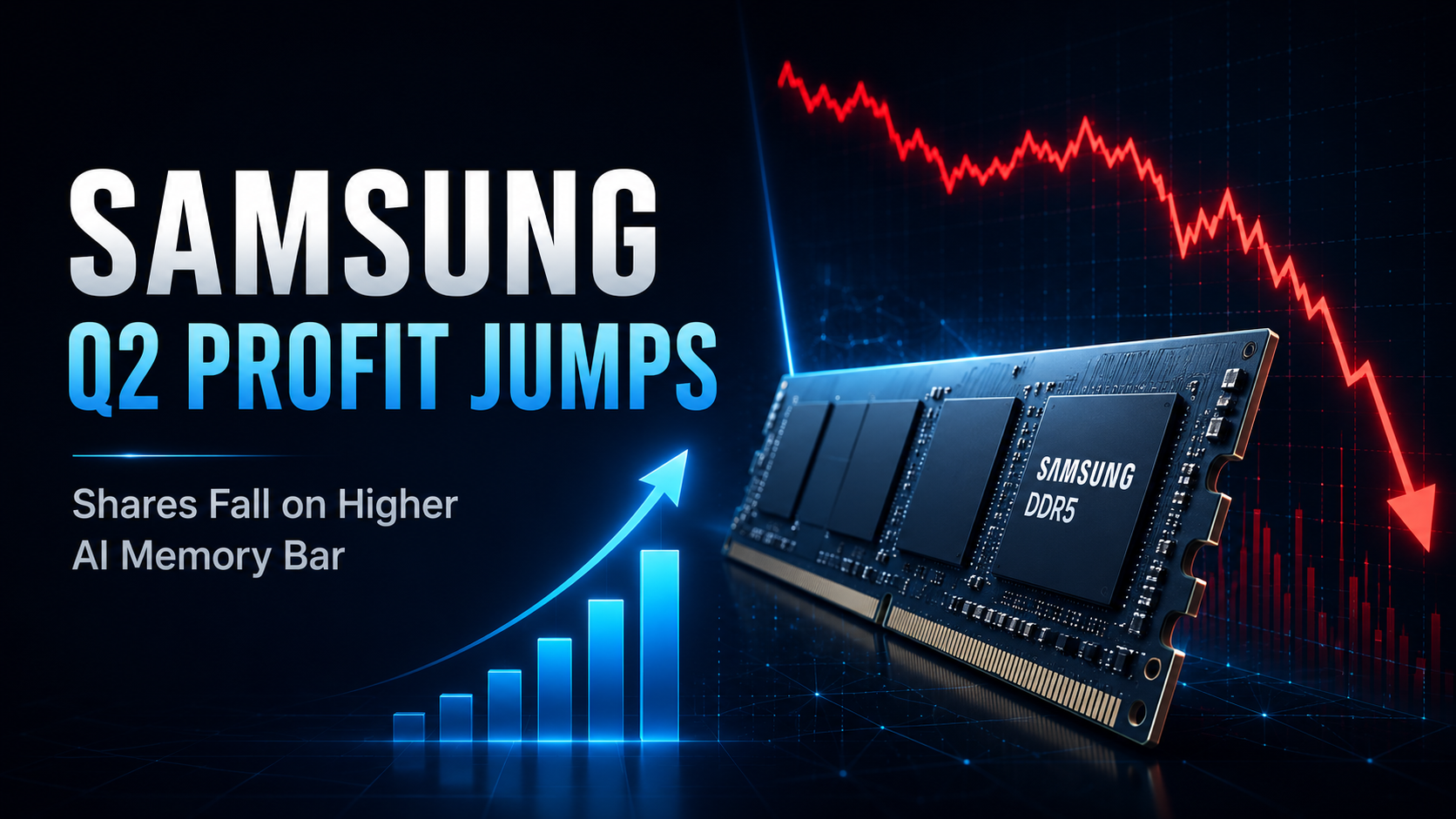
三星電子最近指引其2026年第二季營收約為171兆韓元,營業利潤為89.4兆韓元,較一年前驚人地增加了19倍。從帳面上看,這是迄今為止AI記憶體週期中最強勁的獲利信號之一。
然而,市場拒絕將其視為簡單的財報優於預期來交易。三星股價盤中跌幅高達10.1%,在韓國收盤下跌6.9%,並拖累SK海力士、美光和西部數據等同業。給交易員的信號非常明確:投資者不再只是詢問AI記憶體需求是否強勁。他們現在質疑,在經歷歷史性的全行業漲勢後,當前的記憶體定價、擴大的利潤率以及激進的AI資本支出(Capex)能否持續維持。
2026/07/08
Hyperliquid 未平倉合約達 115 億美元:鏈上永續合約是否正擴展至美國股票市場?
Hyperliquid 的未平倉合約已達到約 115 億美元,創下 2026 年新高,其中 HIP-3 市場貢獻了近 40 億美元。與 S&P 500 掛鉤的合約已成為最大的 HIP-3 市場,而追蹤 SK Hynix 和 Micron Technology 的合約則反映了對 AI 和半導體相關曝險的需求日益增長。
2026/07/28
熱門
目前熱門備受市場關注的加密貨幣
加密貨幣價格
按交易量計算交易量最大的加密貨幣