

1.A New Chapter for Tokenized FinanceThe gap between traditional finance and blockchain technology continues to narrow, and Securitize has taken one of its boldest steps yet. As the company prepares f1.A New Chapter for Tokenized FinanceThe gap between traditional finance and blockchain technology continues to narrow, and Securitize has taken one of its boldest steps yet. As the company prepares f

1.A New Chapter for Tokenized Finance
The gap between traditional finance and blockchain technology continues to narrow, and Securitize has taken one of its boldest steps yet. As the company prepares for its debut on the New York Stock Exchange (NYSE), it has tokenized approximately $295 million worth of its own shares on the Solana and Avalanche blockchains.
The move is more than a technological showcase. It demonstrates how blockchain infrastructure can be integrated into regulated financial markets while maintaining compliance with existing securities laws. At a time when real-world asset (RWA) tokenization is emerging as one of the fastest-growing segments of the digital asset industry, Securitize’s initiative offers a glimpse into how public companies may manage and distribute equity in the years ahead.
2.What Has Securitize Done?
Securitize is widely recognized as a leader in tokenized securities, helping financial institutions issue and manage blockchain-based investment products. Instead of limiting this technology to client assets, the company has now applied it to its own corporate equity.
Ahead of its planned NYSE debut through its business combination with Cantor Equity Partners II, Securitize placed approximately $295 million of company shares on the Solana and Avalanche networks. These blockchain-based tokens represent actual ownership interests in the company rather than simply tracking its share price.
Unlike many earlier blockchain-based stock products that relied on synthetic or derivative structures, Securitize’s tokenized shares are directly linked to the company’s official capitalization table. This means the blockchain serves as an extension of the company’s shareholder records while remaining subject to applicable securities regulations.
As Securitize Co-Founder and CEO Carlos Domingo explained:
“A lot of people that today say that they tokenize equities, they’re not tokenizing equity. We’re going to see a new market emerge in parallel that will run on blockchain rails and be much more efficient.”
That distinction highlights why the announcement has attracted significant attention across both the crypto and traditional finance industries.
3.Why Solana and Avalanche?
Rather than relying on a single blockchain, Securitize chose two networks that complement one another.
Solana has established itself as one of the fastest public blockchains, capable of processing thousands of transactions per second while keeping transaction costs low. These characteristics make it well suited for applications that may eventually require high trading volumes and frequent settlements.
Avalanche, on the other hand, has become a preferred blockchain for many institutional projects due to its rapid transaction finality, customizable infrastructure, and growing adoption among financial firms.
By using both networks, Securitize avoids depending on a single blockchain while giving investors and institutions greater flexibility. A multi-chain strategy also improves resilience as the tokenized asset ecosystem continues to evolve.
4.Why This Is Different From Previous Tokenized Stocks
Tokenized stocks are not a new concept, but many earlier offerings were structured as synthetic products issued by third parties. Those tokens often mirrored the price of publicly traded shares without providing direct legal ownership of the underlying company.
Securitize has taken a different approach.
Its tokenized shares are issued directly by the company and are tied to actual equity ownership. As a regulated transfer agent and broker-dealer, Securitize can integrate blockchain technology into its shareholder records while operating within established securities laws.
This distinction makes the initiative considerably more meaningful than simply creating blockchain-based versions of publicly traded stocks. Instead, it demonstrates how blockchain can become part of the official infrastructure supporting corporate ownership.
5.How Blockchain Could Modernize Stock Markets
One of the strongest arguments for tokenized securities is their potential to improve the efficiency of financial markets.
Traditional equity transactions typically pass through multiple intermediaries, including brokers, clearinghouses, custodians, and transfer agents. Although these systems have proven reliable, settlement often takes time and involves significant administrative work.
Blockchain technology offers a more streamlined alternative.
Because ownership records are maintained on a shared digital ledger, transfers can occur much more efficiently while reducing reconciliation between multiple parties.
5.1 Potential benefits include:
Faster settlement and reduced counterparty risk.
Greater transparency for issuers and investors.
Real-time visibility into shareholder records.
Lower administrative costs through automation.
Smart contract functionality for dividend payments and corporate actions.
The potential for tokenized assets to interact with broader digital financial infrastructure in the future.
Carlos Domingo summarized the vision by stating:
“Tokenization is most powerful when it combines quality assets with the speed, efficiency and accessibility of blockchain infrastructure.”
6.Challenges Still Need to Be Addressed
Despite its promise, tokenized equity is still developing.
Regulation remains one of the industry’s biggest challenges. Securities laws differ across countries, requiring platforms to maintain strict Know Your Customer (KYC) and Anti-Money Laundering (AML) compliance even when assets are issued on public blockchains.
Liquidity also remains limited compared with traditional stock exchanges. While global equity markets process trillions of dollars in trading activity, tokenized securities are still building the market depth needed for widespread institutional participation.
Interoperability between blockchain networks is another ongoing area of development. Although multiple chains now support tokenized assets, ensuring seamless movement across ecosystems will be essential as adoption grows.
Nevertheless, institutional momentum continues to build. Large financial firms have increasingly explored tokenized funds, treasury products, and other blockchain-based financial instruments, suggesting that tokenization is gradually moving beyond pilot programs and into real-world financial operations.
7.What This Means for the Future of Capital Markets
Securitize’s decision to tokenize approximately $295 million of its own shares represents more than a company announcement—it reflects a broader shift in how financial markets may operate in the future.
By applying its own technology to its balance sheet while preparing for a public market debut, Securitize has demonstrated confidence in blockchain as a practical component of regulated finance rather than merely an experimental innovation.
The initiative also sends an important signal to other public and private companies considering blockchain-based capital markets. Instead of replacing traditional financial systems, tokenization has the potential to modernize them by improving efficiency while preserving investor protections and regulatory oversight.
8.Final Thoughts
The tokenization of real-world assets has evolved from a promising concept into one of the most closely watched developments in digital finance. Securitize’s decision to place approximately $295 million of its own shares on Solana and Avalanche marks another important milestone in that journey.
While regulatory and market challenges remain, the company’s strategy demonstrates that blockchain is increasingly being used to enhance existing financial infrastructure rather than disrupt it entirely. If institutional adoption continues at its current pace, tokenized equities could become a familiar feature of global capital markets over the coming years.
For now, Securitize’s latest move stands as one of the clearest examples yet of how traditional finance and blockchain technology are beginning to work together to shape the next generation of securities markets.
Disclaimer:This content is for educational and reference purposes only and does not constitute any investment advice. Digital asset investments carry high risk. Please evaluate carefully and assume full responsibility for your own decisions.
市場機遇
4實時價格 (4)
--
----
USD
4 (4) 實時價格圖表
描述:幣圈脈動基於 AI 技術與公開信息,第一時間呈現最熱代幣趨勢。如果想了解更多專業解讀與深度分析,請訪問新手學院。
本頁面分享的文章均源自公開平台,僅供參考。該內容不代表 MEXC 的立場或觀點。所有版權歸 Mubashir 所有。如果您認為任何內容侵犯了第三方的權益,請聯絡 service@support.mexc.com 以便及時刪除。 MEXC 不保證任何內容的準確性、完整性或及時性,且不對基於所提供信息而採取的任何行動負責。本內容不構成財務、法律或其他專業建議,亦不應被解釋為 MEXC 的推薦或認可。如需專家見解和深入分析,請造訪 MEXC 學院。
學習更多 4 知識
查看更多
最佳 CrypFine 替代方案:6 家受追蹤交易所的手續費、信任度與營運紀錄比較
對多數交易者而言,MEXC 是整體表現最強的 CrypFine 替代方案:在 BTCUSDT 的特殊費率下,將合約吃單手續費從 CrypFine 的 0.06% 降至 0.02%,把 41 組現貨交易對的規模擴展到數千個上架幣種,並額外提供受追蹤的 9/10 評分與公開的儲備金證明頁面。 CrypFine 是 2024 年成立的交易所,由科羅拉多州公司 Crypfine LLC 營運,具備FinC
2026/08/18
Tapbit 最佳替代平台:6 大交易所交易量、信任評分與手續費全比較
對多數交易者而言,MEXC 是整體實力最強的 Tapbit 替代平台:BTCUSDT 特惠費率(Special Rate)把合約吃單手續費從 Tapbit 的 0.06% 壓到 0.02%,同時擁有 9/10 的信任評分,比 CoinGecko 給 Tapbit 的 6/10 高出三分——即便 Tapbit 的同日交易量是本系列至今追蹤過最高的一家。 Tapbit 的同日追蹤交易量約 21,400
2026/08/18
最佳 YUBIT 替代交易所:6 家受追蹤交易所的手續費、信任度與聲明查證比較
對多數交易者而言,MEXC 是整體實力最強的 YUBIT 替代交易所:以 BTCUSDT 特別費率的 0% / 0.02%,取代已公布的 0.04% / 0.08% 合約費率;並以受追蹤的 9/10 評分與公開的儲備金證明頁面,取代平台自行聲明的保護措施。 YUBIT 是一家成立於 2020 年 8 月的多資產交易平台,可用單一 USDT 帳戶交易加密貨幣、黃金與股票;但它並未出現在 CoinGe
2026/08/18
4 最新動態
查看更多
西班牙對比利時比分預測:預期結果、勝率走向與比賽前景
2026/07/08
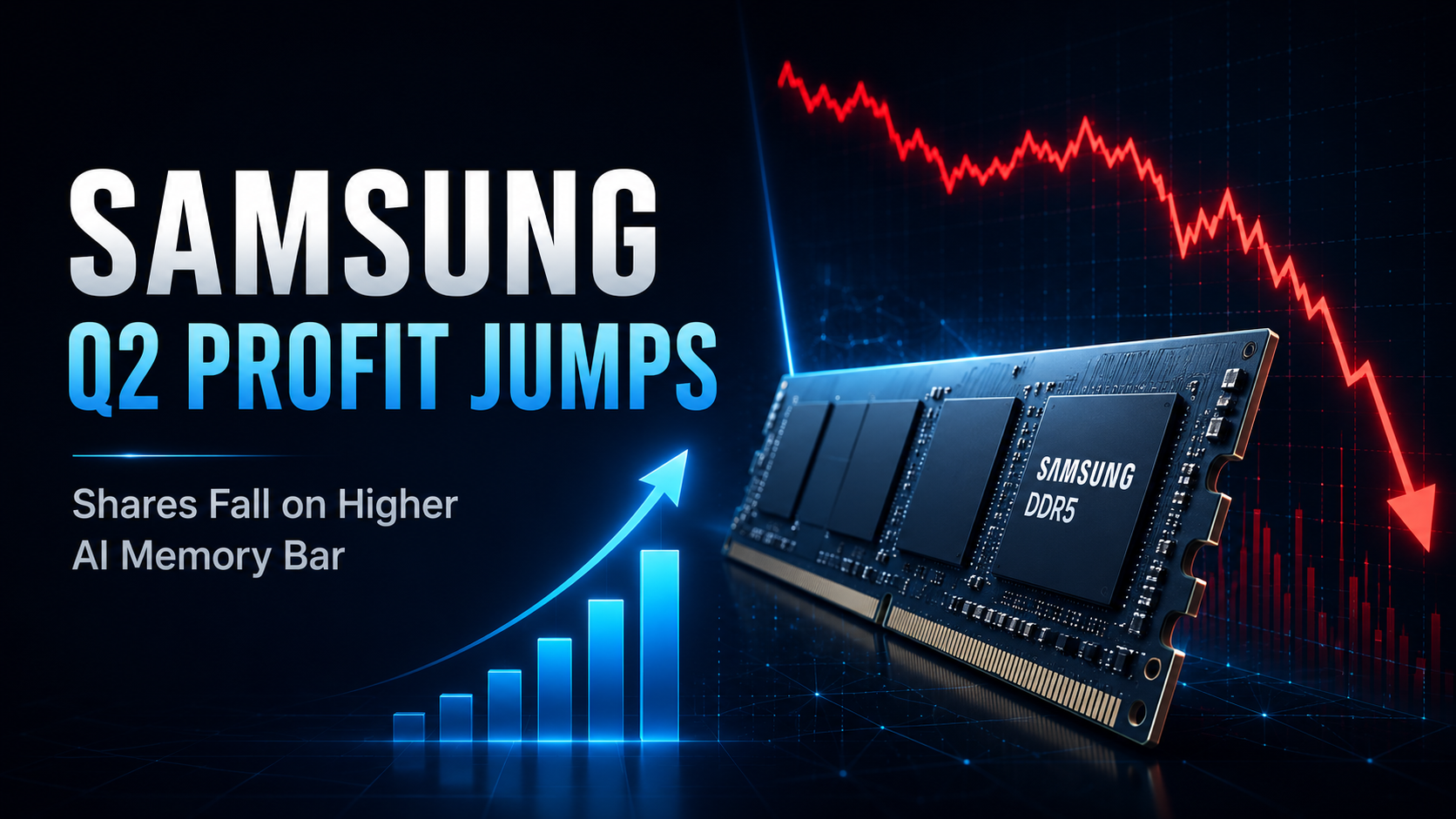
三星第二季獲利飆升19倍,但股價下跌:為何AI記憶體股面臨更高門檻
三星電子最近指引其2026年第二季營收約為171兆韓元,營業利潤為89.4兆韓元,較一年前驚人地增加了19倍。從帳面上看,這是迄今為止AI記憶體週期中最強勁的獲利信號之一。
然而,市場拒絕將其視為簡單的財報優於預期來交易。三星股價盤中跌幅高達10.1%,在韓國收盤下跌6.9%,並拖累SK海力士、美光和西部數據等同業。給交易員的信號非常明確:投資者不再只是詢問AI記憶體需求是否強勁。他們現在質疑,在經歷歷史性的全行業漲勢後,當前的記憶體定價、擴大的利潤率以及激進的AI資本支出(Capex)能否持續維持。
2026/07/08
Hyperliquid 未平倉合約達 115 億美元:鏈上永續合約是否正擴展至美國股票市場?
Hyperliquid 的未平倉合約已達到約 115 億美元,創下 2026 年新高,其中 HIP-3 市場貢獻了近 40 億美元。與 S&P 500 掛鉤的合約已成為最大的 HIP-3 市場,而追蹤 SK Hynix 和 Micron Technology 的合約則反映了對 AI 和半導體相關曝險的需求日益增長。
2026/07/28
熱門
目前熱門備受市場關注的加密貨幣
加密貨幣價格
按交易量計算交易量最大的加密貨幣