Smartphone shipments dropped 7% YoY across the Middle East and Africa in Q1 2026
Smartphone shipments in the Middle East and Africa (MEA) fell by 7% year-on-year (YoY) during the first quarter of 2026. According to a report by Counterpoint Research, the slump was driven by memory chip scarcity and a reduction in entry-tier model devices.
The decline in shipments comes after several quarters of increase, revealing how scarcity and a surge in chip prices, and escalating regional conflicts, have continued to impact importation and exportation of smartphones.
“The decline was due to increasing prices stemming from the memory crisis, as well as the regional conflict in the Middle East, which led to skyrocketing shipping prices and weakened market performance in several countries,” part of the report reads.
The region’s Q1 2026 performance was below projected expectations, with surging memory prices and the unexpected Middle East war changing the flow of prices and shipment dynamics.
While smartphone shipments fell in the region, Samsung maintained the top spot in terms of market share, with 19% YoY growth in MEA. This is attributed to stable prices, high inventory and the launch of its new premium S26 device.
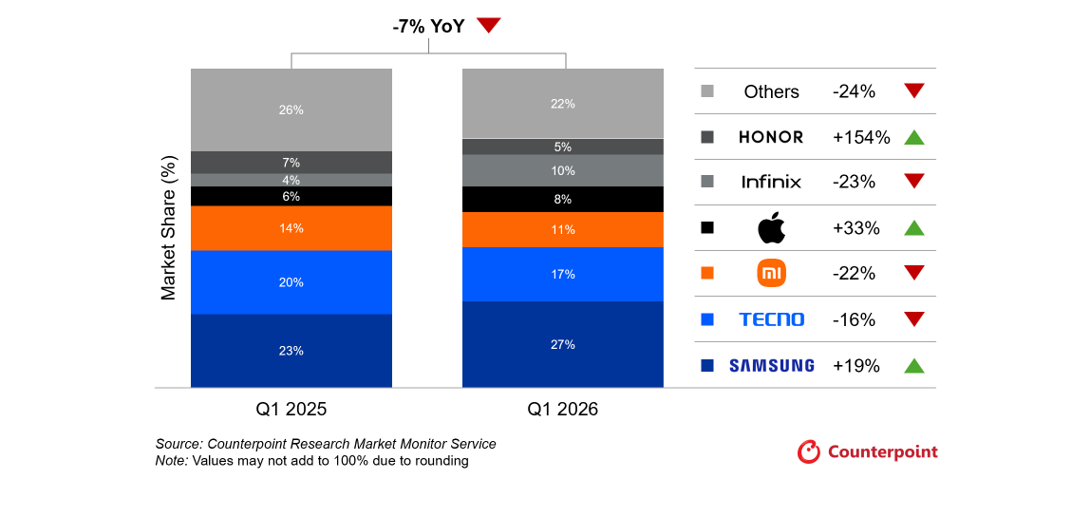 MEA’s smartphone shipments in Q1 2026
HONOR maintained its growth, recording notable growth in the region, surging 154% YoY in Q1 2026, although the brand had a small base in terms of volume last year. Also, Apple saw a 33% growth during the quarter, attributed to continued demand for its iPhone devices.
Chinese smartphone producers such as Transsion and Xiaomi (-22%) suffered a significant drop in shipments, with stocks declining and empty in some cases. They suffered more in the Middle East.
Although Tecno and itel continue to dominate Africa, being their primary market. Infinix also experienced a 23% YoY drop
Also Read: Nigeria’s smartphone shipments grew by 8% in Q1’26, fueled by demand for 4G/5G devices.
Rise in 5G smartphone shipments
5G-smartphone shipments increased by 42% YoY in MEA, fueled by a surge in device adoption. The increase is also attributed to emerging markets experiencing 5G coverage expansion and plans to shut down 2G and 3G networks to create more spectrum for 4G/5G networks.
Aside from growth in 5G-enabled devices, AI-capable smartphones have seen a significant 64% YoY growth during the quarter. The report noted that a significant part of the growth is still happening at the higher end ($400) of the market.
 Smarphones
This means the premium segment continues to capture the bulk of the AI impact in the region, leaving low-income earners to depend on 4G-enabled devices.
“On the macro side, rising layoffs and corporate downsizing are pushing unemployment higher in the GCC’s premium markets, while spikes in fuel and logistics prices are adding another layer of cost on consumer goods prices across the region,” the report added.
For Q2 2026, the higher prices are expected to push more declines, and will be further influenced by the ongoing geopolitical and macroeconomic difficulties, according to the Counterpoint Research report.


Ayrıca Şunları da Beğenebilirsiniz

GOP lawmakers want nothing to do with Trump's ballroom chaos: report

Not a loophole: Singapore AI export controls let China tap US AI legally

Next Block Expo 2026 in Warsaw Brings Institutional Focus to Crypto


Popüler Haberler
Daha fazla