

-
Bitcoin breaks below $72K support, slipping under $64K and triggering fresh downside fears across crypto markets.
-
Mt. Gox wallet transfers and rising Binance selling pressure are adding fresh uncertainty to Bitcoin’s short-term outlook.
-
On-chain MVRV pricing bands now point toward $54K–$50K as Bitcoin’s next major support zone if weakness continues.
Bitcoin price crash is beginning to look far more serious than a routine pullback. After losing the critical $72,000 support, BTC plunged below $64,000, triggering fresh panic across the crypto market and reviving fears of a deeper selloff ahead. From rising Mt. Gox wallet activity and mounting spot selling pressure to weakening institutional momentum, multiple warning signs are flashing at once. Adding to the concern, on-chain valuation models now suggest Bitcoin could still have room to fall toward $54,000. So, why is Bitcoin price crashing today, and how deep could this correction go? Here’s what the latest data reveals.
Binance Selling Pressure Signals Real Market Weakness
Bitcoin’s Binance Cumulative Volume Delta (CVD) Confirmation Score recently climbed toward 0.80, its highest reading in nearly four months.
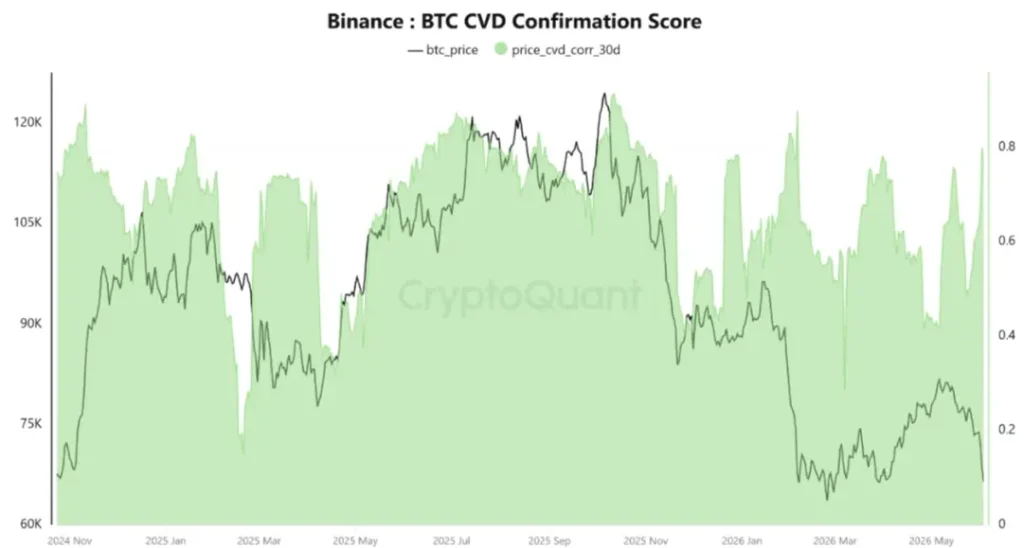
Rising CVD during falling prices often suggests that declines are being driven by real spot selling rather than temporary volatility or thin liquidity conditions. In simpler terms: sellers are actively dominating order books. That distinction matters because market declines backed by strong spot participation tend to last longer unless fresh demand enters aggressively.
Mt. Gox Wallet Activity Revives Market Fear
Adding to the bearish mood, Mt. Gox-linked wallets reportedly transferred 116.3 BTC worth nearly $8.16 million to Bitstamp, reigniting concerns around creditor-related selling pressure. Although the amount moved remains relatively small compared to Bitcoin’s daily trading volume, Mt. Gox-related activity tends to trigger outsized market reactions due to lingering fears of larger exchange deposits and liquidation waves.
With Bitcoin already under pressure following its technical breakdown, the transfer only added another layer of uncertainty to an increasingly fragile market.
MVRV Pricing Bands Flash a Possible $54K Target
One of the strongest warning signals currently comes from Bitcoin’s MVRV Pricing Bands model, a widely followed valuation metric used to identify major support and resistance zones across market cycles.
According to the latest model, Bitcoin’s breakdown below $72,650 may have opened the door toward the next major support region between $54,000 and $50,000. Historically, these valuation bands have acted as important stabilization zones following extended corrections.
This does not guarantee Bitcoin will immediately fall that low, but it suggests downside risks remain elevated unless bulls quickly regain lost structure and reclaim higher resistance levels. For now, $54K is increasingly emerging as the level traders cannot ignore.
On-Chain Data Signals Market Conviction Is Weakening
Latest on-chain data suggests Bitcoin’s weakness may run deeper than short-term panic selling. According to data, BTC has slipped below the True Market Mean near $77,800, a historically important level often separating bullish and bearish market conditions. More notably, the short-term holder cost basis has fallen below this level for the first time since the 2022 bear market, signaling weakening conviction among newer investors.
At the same time, realized losses have surged to nearly $1.35 billion per day, while long-term holders alone account for roughly $770 million in losses, a sign that even experienced investors are beginning to feel pressure.
Can Bitcoin Avoid a Bigger Crash?
Bitcoin price now sits at one of its most important technical and psychological levels of the year. A fast recovery above $70,000–$72,000 could stabilize sentiment and trigger a short-term relief rally. However, failure to reclaim that zone may strengthen the case for a deeper correction toward the $54,000–$50,000 support range, particularly if selling pressure continues and institutional demand remains soft. For now, Bitcoin remains caught between capitulation fears and recovery hopes, with the next few trading sessions likely deciding whether BTC stabilizes, or slides further into correction territory.







