

Paybis says stablecoins are taking over business payments
Paybis said more companies now use stablecoins for international payments, based on a report released at Money20/20 Europe in Amsterdam.
- Stablecoins now make up 86% of Paybis crypto volume, showing payment use is rising fast.
- B2B clients drove 97.8% of stablecoin volume through April, with cross-border payments leading demand growth.
- Survey data shows cost and speed confusion may slow adoption despite clear business use cases.
The crypto platform, which says it serves 7 million users, presented the data as payment firms and banks met at the conference.
The company said 22.5% of surveyed businesses already use stablecoins for cross-border payments or plan to do so within 12 months. The report points to a shift from retail crypto trading toward business payment use.
Paybis said stablecoins made up 86% of its crypto volume in April 2026, compared with 12% in July 2023. That change shows how dollar-linked tokens are moving deeper into business payment flows.
B2B volume drives Paybis stablecoin activity
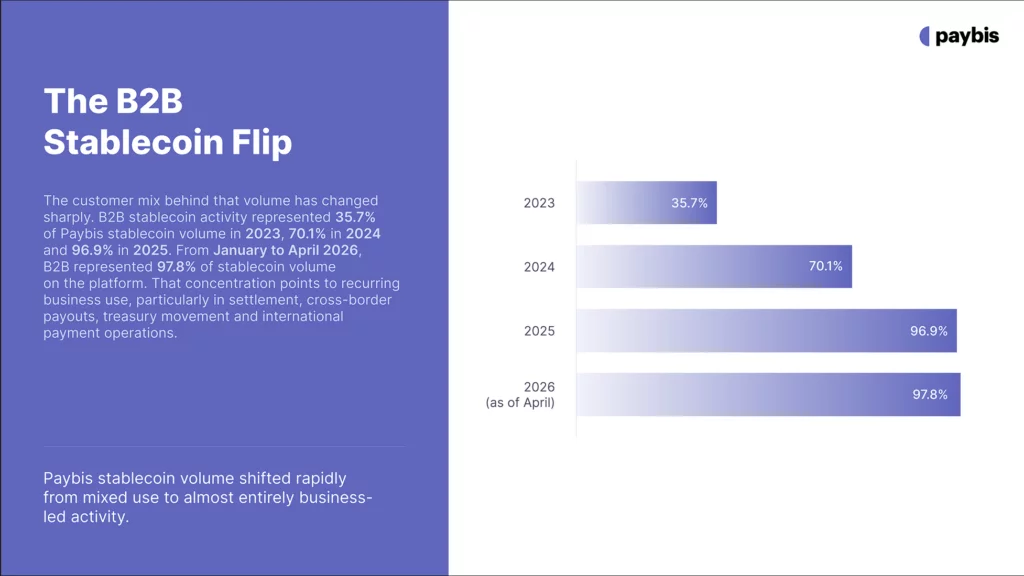
Business clients now account for most stablecoin activity on the platform. Paybis said B2B payments represented 96.9% of stablecoin volume in 2025 and 97.8% from January to April 2026.
The company said total stablecoin volume reached $2.81 billion in May 2026. It also said volume from January to April rose 135% compared with the same period in 2025.
The data fits a wider payments trend. As previously reported by crypto.news, Mastercard has expanded stablecoin settlement support across several blockchains and regulated dollar-backed tokens, including USDC, RLUSD, and PYUSD.
Five sectors lead business stablecoin use
Paybis said stablecoin use is concentrated in sectors that often need fast international settlement. Digital Goods led with 21.4% of B2B stablecoin volume since April 2024.
Virtual Assets Business followed with 15.8%, while Technology held 15.1%. Retail and E-commerce made up 14.5%, and Financial Technology accounted for 11.6%.
Separate crypto.news coverage also showed that banks and corporates in Europe are choosing stablecoin partners under MiCA rules. The demand is tied to payments, settlement, and cross-border treasury movement.
Paybis says confusion still slows adoption
The report also showed a gap between business interest and basic knowledge. Paybis said 53% of respondents expected international stablecoin transfers to settle instantly, while 47% expected settlement to take between one hour and one day.
Cost expectations were also split. About 33.3% expected stablecoin transfer fees to sit near 3%, while 32% selected 0.01%. Paybis said these views may slow adoption because stablecoin payment costs are often below 1%.
“Stablecoins have moved from a crypto niche to business infrastructure,” Paybis Co-Founder and CBDO Konstantins Vasilenko said. He said companies now use stablecoins for faster cross-border settlement and treasury movement.
“What’s missing is plumbing,” he added. Vasilenko said Paybis gives companies one API for stablecoin payment flows, including dedicated IBANs, on-ramp, off-ramp, and crypto rails under its licenses.


Ayrıca Şunları da Beğenebilirsiniz

Pi Network V26 Forecast Sparks Claims of Full Blockchain Economy Shift

UK Reform Party Leads Third-Quarter Fundraising, Bolstered by Crypto Billionaire Donations

S&P 500 Under Pressure: Deutsche Bank Flags AI-Driven Market Concerns


Popüler Haberler
Daha fazla
