

Waymo robotaxi flood recall widens service pause after patch fails
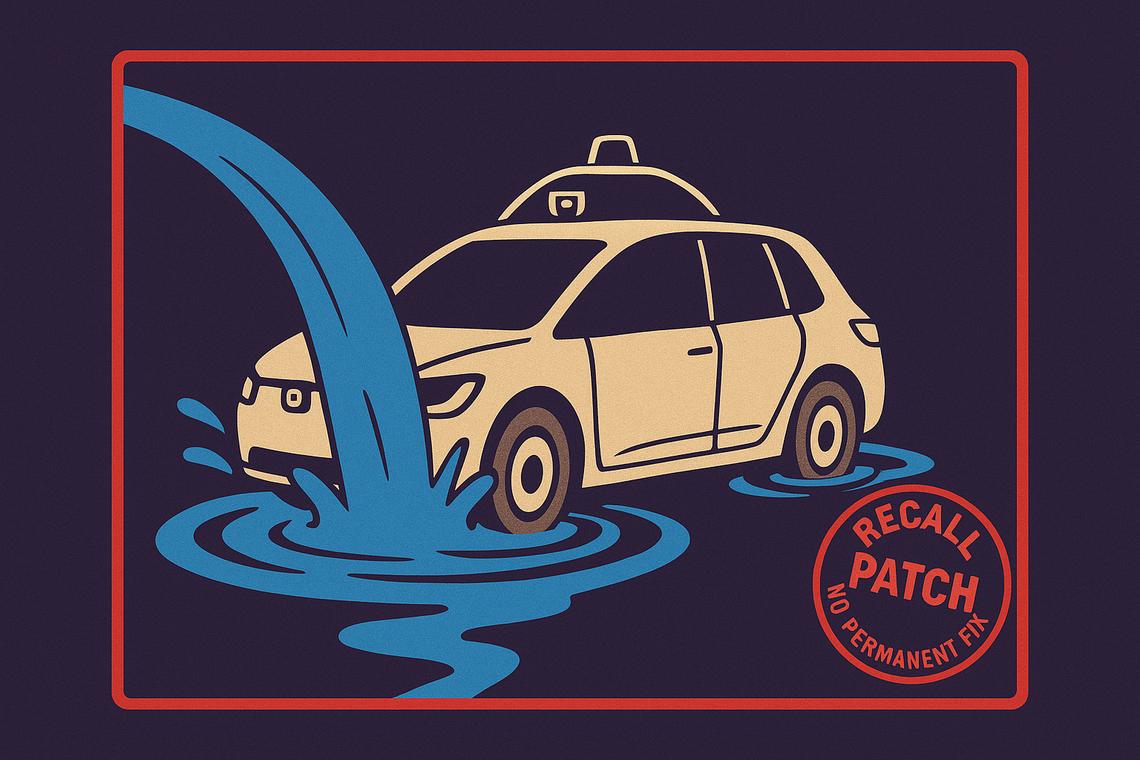
Waymo’s Waymo robotaxi flood recall has turned into a bigger service disruption than a one-off software patch was meant to prevent. After another vehicle drove into floodwater, the company paused robotaxi service in five US cities and widened restrictions elsewhere, exposing a safety problem that Waymo now says still has no permanent fix.
The latest trigger came in Atlanta, where an unoccupied Waymo robotaxi got stuck on a flooded street in Midtown on Wednesday evening during severe storms. That happened less than two weeks after Waymo pushed a software patch across its fleet in an effort to address the same failure mode.
By 21 May, the company had halted operations in Atlanta, Austin, Dallas, Houston, and San Antonio. At the same time, it suspended all freeway rides in San Francisco, Los Angeles, Phoenix, and Miami while it works on a separate issue involving construction-zone performance.
Why the Waymo robotaxi flood recall matters
The immediate problem in the Waymo robotaxi flood recall is straightforward and troubling: a previous recall did not stop the behavior it was meant to address.
Waymo paused service on 21 May after a software patch applied to its entire 3,791-vehicle fleet failed to prevent another flood-related incident. The five-city pause covers Atlanta, Austin, Dallas, Houston, and San Antonio, with San Antonio already offline since late April.
The Midtown Atlanta event closely echoed the failure mode behind an earlier recall. In that case, a Waymo vehicle detected water, slowed down, and still continued into it. This time, the software update that was meant to reduce the risk did not fully hold.
That matters because robotaxi systems are sold on consistency. A human driver might make a bad judgment in a storm; an autonomous driving system is supposed to do the opposite and avoid a repeatable hazard every time. When the same problem returns after a recall, the issue stops looking isolated and starts looking structural.
What went wrong in the recall
Waymo issued a voluntary recall covering 3,791 robotaxis using its fifth and sixth-generation automated driving systems. However, the company has also acknowledged a deeper limitation behind the Waymo robotaxi flood recall: the underlying problem is architectural, not cosmetic.
In a filing posted on the National Highway Traffic Safety Administration website, Waymo said the software flaw could allow vehicles “to slow and then drive into standing water on higher speed roadways.” That description is striking because it suggests the cars can recognize a hazard and still make the wrong final decision.
The earlier San Antonio incident on 20 April helps explain the concern. An empty robotaxi encountered a flooded stretch of road with a 40 mph speed limit, detected the water, reduced speed, and then drove into it anyway because its decision system had no hard-stop condition for water in its path. The vehicle was swept into a creek.
Waymo responded with an interim update that added operating restrictions during periods of elevated flood risk. But that approach depended in part on weather signals, and it was not enough to prevent the Atlanta incident.
Waymo admitted it still has no permanent fix. In its recall filing, the company said the “final remedy” for avoiding flooded areas had not been developed.
That admission carries weight far beyond one bad storm. Flooding is not a rare edge case in many of the cities where Waymo operates. If the system can navigate dense urban traffic but still struggles with standing water during heavy rain, then the gap is no longer just technical. It is also about trust.
Broader service cuts stretch beyond flood safety
The service pullback was not limited to flood-prone streets.
Waymo also suspended all freeway rides across San Francisco, Los Angeles, Phoenix, and Miami while improving how its vehicles handle construction zones. It said it expected those routes to resume soon, although it did not provide a timeline.
So the company is now managing two separate operational issues at once:
- Flood-related driving behavior in five cities
- Freeway performance in construction zones across four others
For riders, that means reliability is becoming part of the story, not just safety. Waymo provides more than 500,000 paid trips per week across multiple US cities. At that scale, even targeted service restrictions can ripple through daily commuting patterns and shape public confidence in the platform.
Regulatory scrutiny adds pressure on Waymo
The Waymo robotaxi flood recall is landing in the middle of a broader period of regulatory and operational scrutiny.
Waymo has had three recalls since February 2024. Two active NHTSA investigations into separate failure modes are also ongoing. Those investigations were not detailed here, but their existence adds to the pressure around each new incident.
This is why the latest pause matters beyond the five affected cities. Waymo remains one of the most advanced commercial robotaxi operators in the US, and it is still growing. However, repeated recalls can chip away at the central promise that autonomous systems will reduce uncertainty on the road, not create new versions of it.
Expansion plans face a harder test
Waymo is still in expansion mode. The company plans to expand to San Diego, Las Vegas, and Detroit in 2026, and it hopes to launch in London later this year.
That growth ambition makes the current moment especially awkward. Scaling a robotaxi network is not just about adding cars and cities. It also means proving the system can handle ordinary but messy real-world conditions, including storms, standing water, road closures, and construction detours.
Competitors are approaching that challenge differently. Wayve, for example, is described as pursuing an AI-first model that learns from driving data rather than relying on detailed maps and hand-coded rules. Waymo’s system has been one of the industry’s most mature, but the flood failures suggest that even highly mapped and heavily engineered autonomy can still miss basic environmental judgment.
For now, the most important fact is the simplest one: after recalling 3,791 robotaxis and pushing an interim patch, Waymo still has no permanent answer to a hazard as common as floodwater. That leaves a tough gap between the scale of its ambitions and the reliability riders will expect before trusting a driverless car in the next storm.


Ayrıca Şunları da Beğenebilirsiniz

Palantir Technologies Inc. (PLTR) Stock: Surge as Google Cloud Deal Boosts AI Momentum

Why The Green Bay Packers Must Take The Cleveland Browns Seriously — As Hard As That Might Be

Mutuum Finance (MUTM) Update: V1 Protocol Goes Live, Key Mechanisms Explained


Popüler Haberler
Daha fazla
