I’ve been watching Hyperliquid for weeks now and the setup keeps getting better. HYPE climbed past $41 today, up over 5% in 24 hours and about 100% off its JanuaryI’ve been watching Hyperliquid for weeks now and the setup keeps getting better. HYPE climbed past $41 today, up over 5% in 24 hours and about 100% off its January

HYPE Eyes $50 as Bitwise ETF Filing Gets Real

2026/04/12 21:01
Okuma süresi: 4 dk
Bu içerikle ilgili geri bildirim veya endişeleriniz için lütfen crypto.news@mexc.com üzerinden bizimle iletişime geçin.

I’ve been watching Hyperliquid for weeks now and the setup keeps getting better. HYPE climbed past $41 today, up over 5% in 24 hours and about 100% off its January lows near $20. Five green days in a row. That’s not noise. That’s a trend with buyers behind it.

And today the story got a lot more interesting.

For on-demand analysis of any cryptocurrency, join our Telegram channel.

What Is the Bitwise Hyperliquid ETF?

It’s a spot ETF that Bitwise is filing to list under the ticker BHYP with a 0.67% expense ratio. They just submitted a second revised filing to the SEC, which usually means the launch is close.

If this thing goes live—and I think it will sometime in April—it gives US investors regulated exposure to HYPE without touching a DEX. That’s a big deal.

Traders on Kraken in the US are already positioning, and I’d expect Binance global volume to spike on any ETF approval headline.

Why Are Whales Buying HYPE?

Because the fundamentals are absurd for an altcoin. A fresh wallet deposited $5 million USDC into Hyperliquid two days ago and used $2.4 million to scoop up 59,000 HYPE at around $40.

Another whale loaded up 200K tokens at $39.2 after dropping $7.86 million onto the platform. These aren’t retail punters flipping memes.

This is calculated accumulation from wallets that don’t mess around. On-chain data from WazirX and CoinDCX in India shows similar bid-side depth building on HYPE pairs.

Is Hyperliquid HYPE a Good Buy Right Now?

I think so, with stops. Hyperliquid controls somewhere between 66% and 73% of all decentralized perps volume. Their weekly volume hit $50 billion. Open interest sits around $7.5 billion—more than three times the next competitor.

The platform pulled in $69 million in fees just in March. These fees go into buybacks and burns. That’s real revenue flowing into token value, not hype. Traders on Upbit in South Korea and Luno across Nigeria are catching onto this. HYPE isn’t a governance token with no utility.

It’s a claim on actual exchange revenue.

Can HYPE Reach $50 in April 2026?

Possible but not guaranteed. The all-time high was $59.30 back in September 2025. Right now HYPE is about 32% below that. The technicals look solid—price is above the 50-day moving average, RSI is at 65 so there’s room to run before overbought territory.

The upcoming Outcomes launch (their prediction market product) and the Bitwise ETF are both catalysts that could push it past the $45 resistance and toward $50.
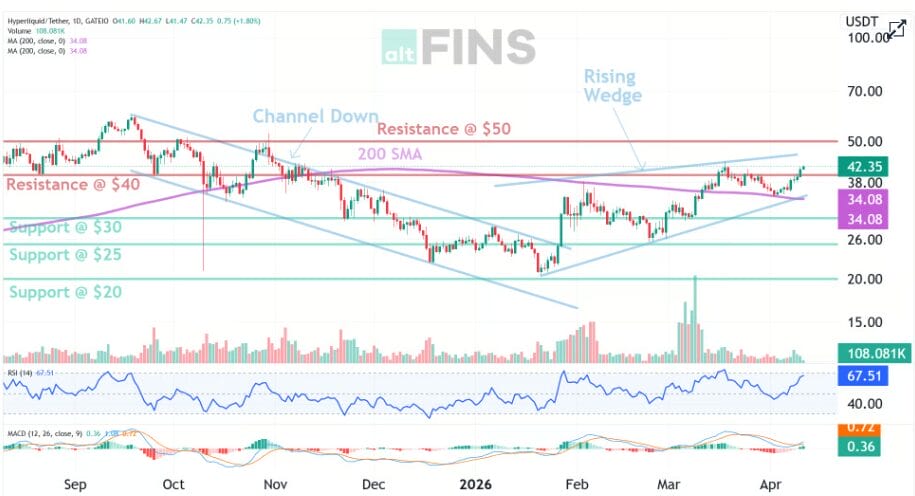
Can HYPE Reach $50 in April 2026?

Price broke above 200 SMA, which signaled resumption of Uptrend. It’s trading in a Rising Wedge pattern. It’s reached and broken above our first price target of $40. Momentum is still fresh (MACD and RSI crossovers) and price could reach $50 (PT2) next. There’s excitment building around their launch of prediction markets (ala Polymarkets, Kaishi, etc.) and increased volumes of contracts on Gold, Silver and other RWAs. This is one of the highest revenue producing blockchain projects. HYPE was featured among our Coin Picks in March and June 2025. 

Buy Now

Arthur Hayes has a $150 target for August which I think is aggressive, but the direction is right.

My Trade Setup

Long HYPE spot. Entry zone: $40.50–$41.50 on any dip toward the Asian session demand zone. Target 1 is $45 (March resistance). Target 2 is $48.50 if the ETF approval catalyst hits. Stop loss below $37.80—if it loses that level, the five-day momentum structure breaks and I’m out.

Only 24.8% of HYPE’s 1 billion max supply is circulating. That’s the risk—future unlocks could dilute. But right now, with whales stacking, an ETF on deck, and $7.5 billion in open interest, the reward-to-risk leans heavily in favor of the long side.

My capital, my risk. Not financial advice. Size accordingly.

For on-demand analysis of any cryptocurrency, join our Telegram channel.

Piyasa Fırsatı
Hyperliquid Logosu
Hyperliquid Fiyatı(HYPE)
$67.9
$67.9$67.9
-5.81%
USD
Hyperliquid (HYPE) Canlı Fiyat Grafiği

SPACEX(PRE) Launchpad

SPACEX(PRE) LaunchpadSPACEX(PRE) Launchpad

Register for a chance to win a free lucky draw

Sorumluluk Reddi: Bu sitede yeniden yayınlanan makaleler, halka açık platformlardan alınmıştır ve yalnızca bilgilendirme amaçlıdır. MEXC'nin görüşlerini yansıtmayabilir. Tüm hakları telif sahiplerine aittir. Herhangi bir içeriğin üçüncü taraf haklarını ihlal ettiğini düşünüyorsanız, kaldırılması için lütfen crypto.news@mexc.com ile iletişime geçin. MEXC, içeriğin doğruluğu, eksiksizliği veya güncelliği konusunda hiçbir garanti vermez ve sağlanan bilgilere dayalı olarak alınan herhangi bir eylemden sorumlu değildir. İçerik, finansal, yasal veya diğer profesyonel tavsiye niteliğinde değildir ve MEXC tarafından bir tavsiye veya onay olarak değerlendirilmemelidir.

Ayrıca Şunları da Beğenebilirsiniz

Pi Network V26 Shock Prediction Could Change Pi Coin Forever

Pi Network V26 Shock Prediction Could Change Pi Coin Forever

Pi Network V26 Shock Prediction Could Change Pi Coin Forever Pi Network is once again becoming one of the hottest topics in the crypto world after growing
Paylaş
Hokanews2026/06/04 18:44
USDH Power Struggle Ignites Stablecoin “Bidding Wars” Across DeFi: Bloomberg

USDH Power Struggle Ignites Stablecoin “Bidding Wars” Across DeFi: Bloomberg

A heated contest for control over a new dollar-pegged token has set the stage for what analysts say could define the next phase of the stablecoin industry. According to Bloomberg, a bidding war unfolded on Hyperliquid, one of crypto’s fastest-growing trading platforms, with the prize being the right to issue USDH, its native stablecoin. The competition drew some of the sector’s most prominent names, including Paxos, Sky, and Ethena, who later withdrew their bid, alongside the lesser-known Native Markets, a startup backed by Stripe stablecoin subsidiary Bridge. Hyperliquid Stablecoin Race Shows Branding and Partnerships Matter as Much as Tech Over the weekend, Hyperliquid’s validators, the contributors who secure the network and vote on key decisions, awarded the USDH contract to Native Markets over the weekend. Despite its relatively new status, the firm’s connection with Stripe helped it outpace more established rivals. Stablecoins underpin decentralized finance by providing a dollar-backed medium for collateral, settlement, and payments across applications. What began as a grassroots, community-led sector has evolved into a battleground for institutions and payment companies seeking revenue from interest on reserves. Circle, for example, shares proceeds from its USDC with Coinbase under a partnership designed to stabilize earnings during market swings. The Hyperliquid contest offered a rare glimpse into just how intense competition has become. Paxos pledged to take no revenue until USDH surpassed $1 billion in circulation. Agora offered to share 100% of net revenue with Hyperliquid, while Ethena put forward 95%. All were outbid by Native Markets, whose ties to Stripe’s $1.1 billion acquisition of Bridge and subsequent rollout of the Tempo blockchain positioned it as a strong contender. “Every stablecoin issuer is extremely desperate for supply,” said Zaheer Ebtikar, co-founder of Split Capital. “They are willing to publicly announce how much they are willing to offer. It just shows it’s a very tough business for stablecoin issuers.” While USDC remains dominant on Hyperliquid with more than $5.6 billion in deposits, the arrival of USDH could shift flows and revenue dynamics. Paxos co-founder Bhau Kotecha said the firm sees the exchange’s growth as an important opportunity, while Agora’s co-founder Nick van Eck warned that awarding the contract to a vertically integrated issuer risked undermining decentralization. Regulatory positioning also factored into the debate. Paxos operates under a New York trust charter and is seeking a federal license, while Bridge holds money transmitter approvals in 30 states. Native Markets, in a blog post, cited regulatory flexibility and deployment speed as reasons for its selection. Hyperliquid said the strong engagement from its community validated the process. Circle CEO Jeremy Allaire dismissed concerns over USDC’s status, noting on X that competition benefits the ecosystem. Analysts suggested that fears of centralization may be exaggerated, noting that Hyperliquid is likely to remain neutral and support multiple stablecoins. Still, the contest over USDH highlighted a new reality for stablecoins: branding, partnerships, and business strategy are becoming as decisive as technology. Native Markets Secures USDH Stablecoin Mandate on Hyperliquid Hyperliquid has concluded its governance vote for the USDH stablecoin, awarding the mandate to Native Markets after a closely watched process that drew weeks of community debate and rival proposals. USDH, described by Hyperliquid as a “Hyperliquid-first, compliant, and natively minted” dollar-backed token, is intended to reduce the platform’s dependence on USDC and strengthen its spot markets. Validators on the decentralized exchange voted in favor of Native Markets, a relatively new player backed by Stripe’s Bridge subsidiary, over established contenders including Paxos and Ethena. The outcome followed a string of proposals offering aggressive revenue-sharing terms to win validator support, underscoring the scale of incentives attached to controlling USDH. Hyperliquid’s exchange has become a critical hub for stablecoin liquidity, with $5.7 billion in USDC, around 8% of its total supply, currently held on the network. At prevailing treasury yields, that translates to an estimated $200 million to $220 million in annual revenue for Circle, underlining why a native alternative could be transformative. Hyperliquid’s validators, who secure the network and vote on key decisions, selected Native Markets following an on-chain governance process that concluded September 15. Native Markets has laid out a phased rollout for USDH, beginning with capped minting and redemption trials before expanding into spot markets. Its reserves will be managed in cash and treasuries by BlackRock, with on-chain tokenization through Superstate and Bridge. Yield from those reserves will be split between Hyperliquid’s Assistance Fund and ecosystem development. The launch of USDH comes as Hyperliquid records record profits from perpetual futures trading, with $106 million in revenue in August alone, and prepares to slash spot trading fees by 80% to bolster liquidity. Analysts say the move positions Hyperliquid to capture more of the stablecoin economics internally, marking a significant step in its bid to rival the largest players in decentralized finance
Paylaş
CryptoNews2025/09/18 00:48
Strategy Didn’t Sell Bitcoin in May, According to Polymarket

Strategy Didn’t Sell Bitcoin in May, According to Polymarket

Strategy's sale of 32 BTC in May sparked one of the most contentious debates around Polymarket's resolution criteria.
Paylaş
CryptoPotato2026/06/04 18:13

RealStocks Now Live

RealStocks Now LiveRealStocks Now Live

Trade real U.S. stock via regulated brokerage


