Circle Stock Decline Hits 40% as Visa, BlackRock Back USDC Rival
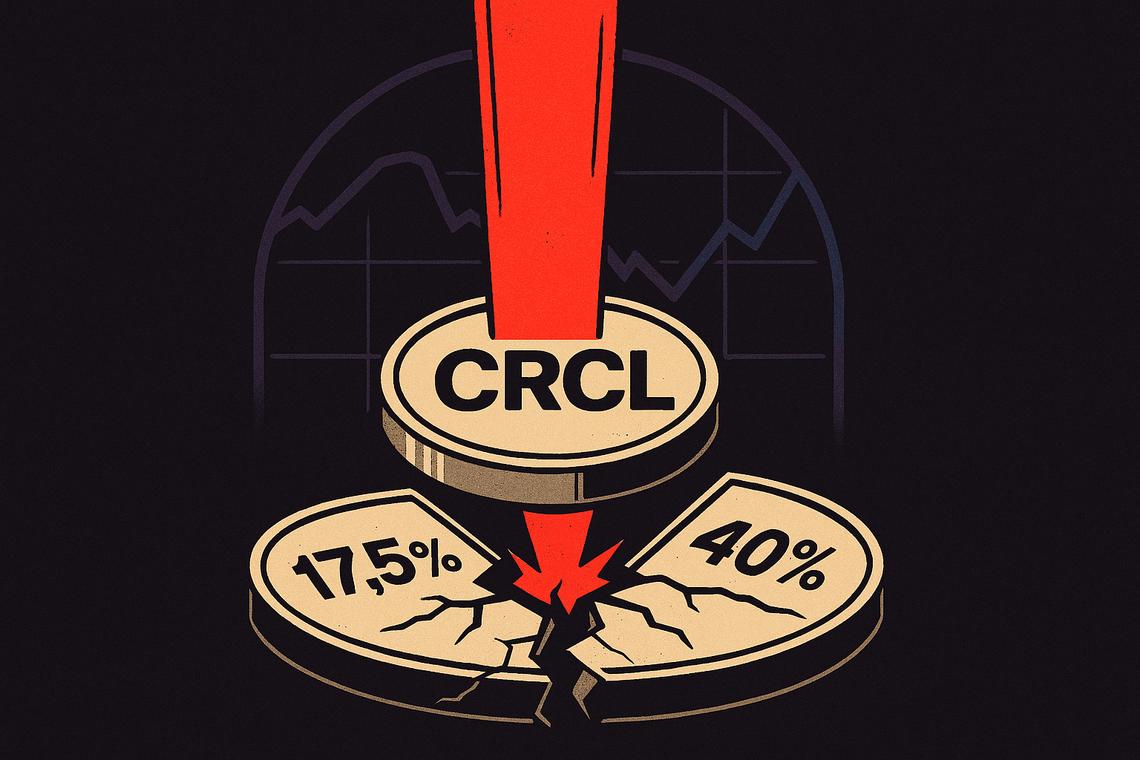
Circle’s stock decline has become one of the more dramatic stories in crypto markets this week — and it isn’t driven by just one thing. Shares of Circle Internet Group (CRCL) dropped 17.5% in a single session, hitting an intraday low of $62.00 after opening at $72.68, as two separate pressures converged at almost exactly the same moment: a structural shakeout from major equity benchmarks and the arrival of a well-funded rival stablecoin backed by some of the biggest names in global payments.
Key takeaways
- CRCL fell 17.5% in one session and has now lost roughly 40% of its value over the past 30 days.
- FTSE Russell’s June 2026 reconstitution removed Circle from the Russell 1000 Growth, Russell 3000 Growth, and Russell Midcap Growth indexes.
- Open Standard launched Open USD, a new dollar-pegged stablecoin backed by over 140 companies including Visa, Mastercard, Coinbase, Stripe, and BlackRock.
- Unlike USDC, Open USD offers free minting and redemption and shares reserve earnings with ecosystem partners rather than keeping them for the issuer.
- Analysts are divided: some call the selloff an overreaction, while others acknowledge Open USD represents a genuine structural challenge to Circle’s business model.
Circle Stock Declines Amid Russell Index Removals
The index removal story began quietly but landed hard. During FTSE Russell’s annual reconstitution in June 2026, Circle was cut from several growth benchmarks simultaneously — the Russell 1000 Growth Index, the Russell 3000 Growth Index, and the Russell Midcap Growth Index. The process, which updated growth, value, and size-based benchmarks as market leadership shifted, triggered mechanical selling from index-tracking funds and institutional mandates that mirror those benchmarks.
That kind of forced selling doesn’t reflect a fundamental judgment on a company. But it creates real price pressure, especially for a stock already carrying momentum concerns.
A 40% slide in 30 days
The session drop was striking on its own. What makes it harder to dismiss is the trajectory leading up to it. CRCL had already fallen roughly 40% over the prior 30 days, a move analysts partly attribute to selling pressure tied to the anticipated index removal. When the reconstitution was formally confirmed, whatever cushion remained gave way.
Clear Street managing director Owen Lau told CoinDesk he thinks the roughly 16% single-day selloff went further than the facts justified. “I think it is an overreaction,” he said, while acknowledging that the new stablecoin competition will continue to weigh on near-term sentiment until Open USD actually launches later this year.
Still, calling it an overreaction doesn’t make the pressure disappear. Index removal changes who holds the stock and how much passive capital flows through it — and those shifts don’t reverse overnight.
Launch of Open USD Stablecoin Challenges Circle’s USDC
The same day Circle was absorbing index-related pressure, Open Standard unveiled Open USD — a new U.S. dollar-pegged stablecoin backed by more than 140 businesses, including Visa, Mastercard, Coinbase, Stripe, and BlackRock. The consortium is led by founding CEO Zach Abrams, who previously co-founded Bridge, a payments infrastructure company acquired by Stripe.
The sheer weight of that partner list immediately attracted attention. Some observers on social media went as far as calling it an “existential threat” to Circle. That framing may overstate the near-term risk, but the structural challenge is real.
A fundamentally different business model
The key tension isn’t just about competition for stablecoin supply — it’s about competing economic models. Circle’s USDC generates revenue primarily by retaining the interest earned on the reserves backing the stablecoin. That reserve income is the core of Circle’s business.
Open USD takes the opposite approach. It offers free minting and redemption and distributes reserve earnings back to ecosystem participants after a management fee. In other words, the yield that Circle keeps, Open Standard plans to share.
Rob Hadick, general partner at venture capital firm Dragonfly, described the partner lineup as a clear signal of intent. He pointed specifically to Stripe’s broad financial product suite as something that could “uniquely undercut Circle’s economics.” At the same time, Hadick cautioned that “consortiums are hard and they break easily,” noting that incentives across more than 140 partners are “broad and often misaligned.”
There’s also a relevant precedent that gives pause. Paxos’ Global Dollar Network (USDG), another consortium-backed stablecoin that similarly shares reserve income with partners, has grown to roughly $3 billion in supply since launching in late 2024 — a fraction of USDC’s $73 billion or Tether’s USDT at $145 billion, according to CoinDesk data. Assembling high-profile partners is one thing. Driving consumer and enterprise adoption at scale is something else entirely.
Noelle Acheson, author of the Crypto Is Macro Now newsletter, noted that the Open Standard announcement left important questions unanswered — including the consortium’s ownership structure, which blockchains Open USD will launch on, and exactly how reserve income will be distributed among the more than 140 participants. Those gaps matter for anyone trying to model the actual competitive threat.
The Coinbase dimension
One subplot that added complexity: Coinbase is both a backer of Open Standard and a long-standing partner of Circle. The two companies jointly founded the Centre Consortium that originally issued USDC, and they continue to share economics tied to USDC’s reserve income under a commercial agreement that is reportedly up for renewal in August. Dragonfly’s Omar Kanji suggested the Open Standard announcement makes a potential breakup between Circle and Coinbase appear more plausible — though he ultimately expects both companies to renew their agreement, likely with revised economics.
Industry Leaders Address Stablecoin Market Competition
Circle CEO Jeremy Allaire didn’t wait long to respond. In a post on X, he defended USDC’s standing directly: “USDC remains the most trusted, widely adopted, institutional-ready stablecoin in the world.” He added that Circle would continue investing across banks, payment companies, capital markets firms, and enterprise use cases — framing the arrival of new competition as something Circle intends to compete through, not around.
Allaire also underscored the broader thesis: “Stablecoins represent one of the largest market opportunities in the world as the internet transforms the infrastructure for storing and moving money.”
Tether CEO Paolo Ardoino took a different tone — almost welcoming. His response on X was brief: “Welcome OUSD. Player 2 has entered the game.” With USDT sitting at $145 billion in supply and comfortably ahead of every competitor, Ardoino can afford to watch the newcomer with curiosity rather than alarm.
What this means for stablecoin investors
Jeff Dorman, CIO of investment firm Arca, offered what may be the sharpest analytical take: the stablecoin opportunity extends well beyond any single issuer. As digital dollars move deeper into mainstream finance, the bigger winners may not be the companies minting stablecoins but the exchanges, payment processors, wallets, custodians, and blockchain networks that distribute and settle them. “The stablecoin opportunity extends far beyond Circle, Tether, or any single issuer,” Dorman told CoinDesk.
That framing reframes the entire debate. Open USD’s arrival doesn’t just threaten USDC — it accelerates a broader shift in how stablecoin competition works. The battleground is increasingly about distribution reach and partner economics, not just brand trust or regulatory standing. Circle built its position on institutional credibility and regulatory compliance. Whether that moat holds as yield-sharing models enter with powerful distribution networks behind them is the question investors are now pricing in — even if they can’t fully answer it yet.
FAQ
Why did Circle’s stock CRCL fall recently?
CRCL fell 17.5% in a single session after Circle was removed from multiple Russell Growth indexes — including the Russell 1000 Growth, Russell 3000 Growth, and Russell Midcap Growth — during FTSE Russell’s June 2026 reconstitution. That removal triggered selling from index-tracking funds. The drop compounded a broader 40% decline over the prior 30 days, and coincided with the launch of Open USD, a competing stablecoin backed by over 140 companies.
What is Open USD and how does it compete with USDC?
Open USD is a new U.S. dollar-pegged stablecoin issued by Open Standard, a consortium backed by more than 140 companies including Visa, Mastercard, Coinbase, Stripe, and BlackRock. Unlike USDC, which retains reserve income as its primary revenue source, Open USD offers free minting and redemption and shares reserve earnings with ecosystem participants. That revenue-sharing model directly challenges Circle’s core economics.
How did Circle’s CEO respond to the new stablecoin competition?
CEO Jeremy Allaire defended USDC’s position on X, calling it “the most trusted, widely adopted, institutional-ready stablecoin in the world.” He said Circle would continue investing across banks, payment companies, capital markets firms, and enterprise use cases, framing the competitive challenge as one Circle plans to meet head-on.
What changes did FTSE Russell make that affected Circle?
FTSE Russell reconstituted its U.S. equity benchmarks in June 2026, updating growth, value, and size-based indexes as market leadership shifted. The process removed Circle from several Russell Growth indexes, which can prompt index-linked funds and institutional mandates to reduce their exposure to CRCL — creating passive selling pressure around rebalancing dates.
Article produced with the assistance of artificial intelligence and reviewed by the editorial team.


You May Also Like

Why The Green Bay Packers Must Take The Cleveland Browns Seriously — As Hard As That Might Be

Crypto Hack: Drift Protocol Drained Over $200M in Private Key Breach