Alphabet Gets +4% Bump After Joining the Dow, Gving Wall Street's Blue-Chip Index a Tech Boost
Key highlights:
- Alphabet rose more than 4% on its first day as a Dow Jones Industrial Average member
- The company replaced Verizon, increasing the Dow's exposure to AI and technology
- There are still concerns about Alphabet's AI spending despite strong revenue growth
Google's parent company Alphabet officially joined the Dow Jones Industrial Average on Monday despite its stock struggles. This pushed the Dow above 52,000 for the first time in its history.
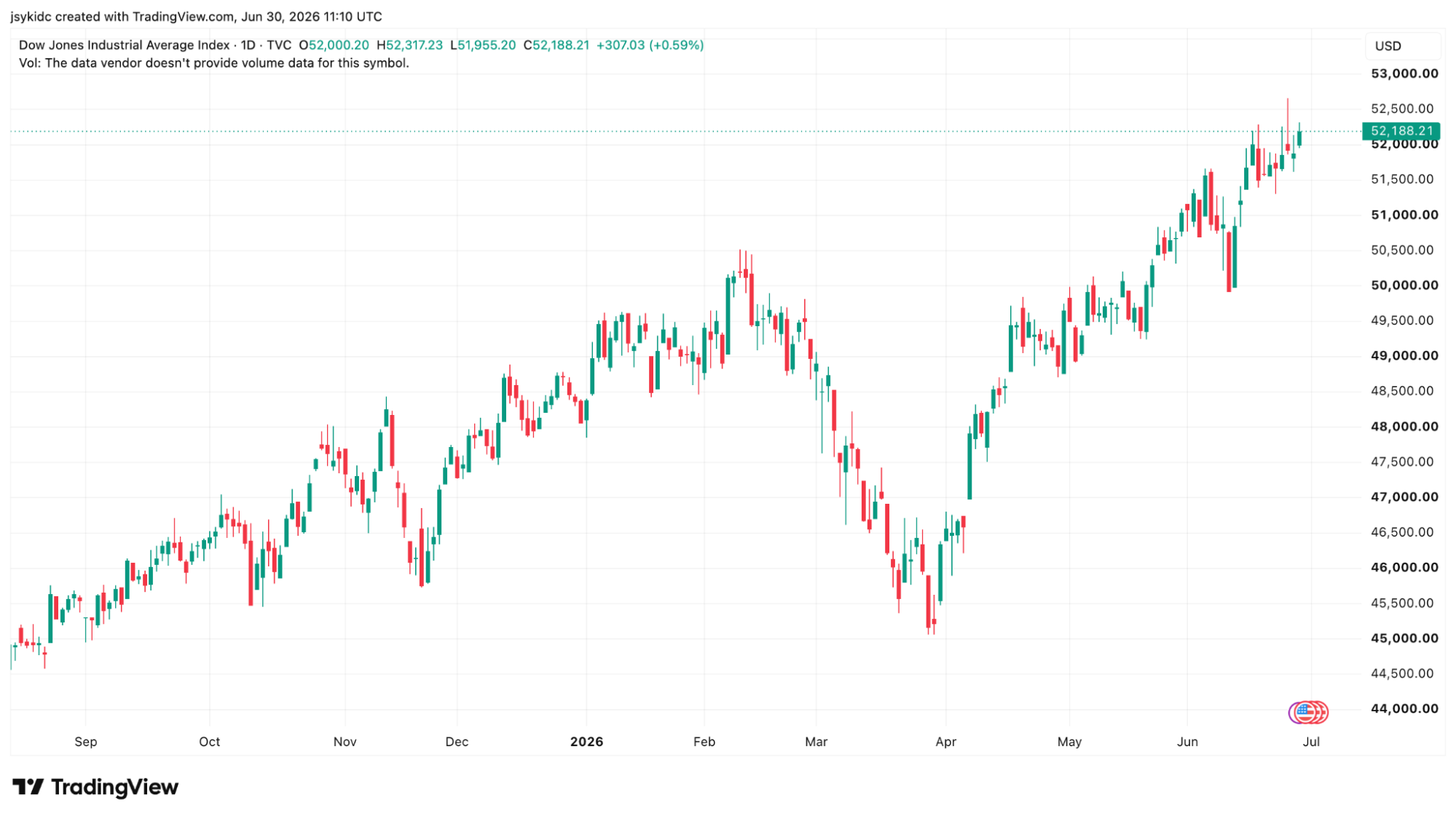
The Dow Jones Industrial Index. Source: TradingView
The index gained 306 points, closing the day at a record high of 52,182.74. The S&P 500 also rose by almost 1%, while the Nasdaq climbed 1.5%. This puts both indexes on track to end a losing streak that has lasted five sessions.
Why Alphabet's addition matters
Shares of Google’s parent firm gained around 4% during their first day as a member of the famous 30-stock index. This gave investors a strong start to the company's new chapter.
The firm replaced Verizon in the Dow after index provider S&P Dow Jones Indices announced the change on June 23. Because the Dow is a price-weighted index, premium stocks like Alphabet have a great influence on how it performs.
The change expands the Dow's exposure to sectors like digital advertising, cloud computing, and AI. It also increases the number of "Magnificent Seven" technology companies in the index to five. Alphabet joins Microsoft, Apple, Amazon, and Nvidia.
There are also disadvantages to this inclusion. The company is already a major part of the S&P 500 and the Nasdaq 100. This is where the majority of investment funds are based. According to S&P Dow Jones Indices, about $115 billion in assets were tied to the Dow as of the end of 2024. Meanwhile, about $20 trillion was linked to the S&P 500.
Investors still have questions about AI spending
The firm is at the receiving end of concerns about how much it is investing in AI. The stock is heading toward its weakest month since February 2025. Its shares are down about 7% over the past month. During the same period, the Dow has gained 2%.
The management has projected capital expenditures of between $175 billion and $185 billion for 2026. This nearly doubles the $91.45 billion spent on AI in 2025. Even with its strong revenue, investors are questioning how fast those investments will bring in returns.
In the first quarter of 2026, revenue grew 21.8% year-over-year to $109.9 billion. Google Cloud was the standout performer. Its growth is reaching 63%, and a backlog exceeding $460 billion. However, free cash flow fell 46.6% to $10.12 billion amid the AI spending.
This comes while still facing competition in AI. Lower-cost models from Chinese developers are putting pressure on pricing, while some researchers have left for rivals such as OpenAI and Anthropic.
Reports have also suggested that demand for AI computing power is growing faster than the available capacity. This is yet another challenge for the company.
Markets rally alongside Alphabet's debut
The overall market saw a boost amid other developments beyond Alphabet's Dow debut. Investors cashed in after a pause in tensions between the US and Iran was announced. The countries agreed to halt hostilities and reopen the Strait of Hormuz to commercial shipping. The easing of geopolitical fears helped lift market sentiment.
Also, oil prices moved higher. Brent crude has been around the $71 to $74 per barrel range, and West Texas Intermediate at $71.
In other developments, Comcast shares jumped about 7% after announcing plans to split its media and technology businesses into two publicly traded companies.


You May Also Like

Fox News chief analyst rips into Trump for getting strung along on major issue

BREAKING: Provenance Blockchain (HASH) Crashes 22% to $0.0104