We’ve Been Teaching Financial Literacy Wrong

For decades, standard financial literacy programs have prescribed a reliable, albeit static, formula: track your spending, build a rainy-day fund, and allocate a fixed percentage of your paycheck to passive index funds. It is a defensive framework designed for wealth preservation and basic financial stability.
Now a fundamental shift is underway with retail investors. Driven by the new age of unprecedented, uninterrupted access to global markets, real-time data, and advanced technology, a new generation is actively engaged in the market. Gen Z is investing earlier than any previous generation, but scoring the lowest in financial literacy, as the gap between access to markets and the skills needed to navigate grows.
What is taking its place is financial performance literacy: the high-level psychological and technical skill set required to navigate, analyze, and manage capital actively under modern market conditions. This educational evolution is built into the mission of trading platforms like LEVERAGED, built around the thesis that everyone is a trader because active market competence is a learnable, performance-based discipline.
The Gap in Traditional Education
Traditional financial education treats the markets as a black box where money is deposited and left to mature over decades. This approach remains foundational for long-term retirement planning, but it leaves individuals entirely unequipped for active risk management.
When retail investors attempt to bridge this gap, they often run into structural barriers. Theoretical knowledge, such as reading books on chart patterns or understanding macroeconomic definitions, is not the same as dealing with the stress of real time market volatility.
The execution gap: Knowing the definition of risk management is entirely different from enforcing a strict daily loss limit when a position moves against you in real time.
This disconnect highlights why conventional trading courses fail. They treat the markets as an academic subject rather than an environment requiring active execution and strict control under pressure.
Market Navigation is a Performance Sport
To understand how modern market education is evolving, one should look outside of finance entirely. In high-stakes environments like motorsport, performance under pressure is not taught in a classroom. A racing driver does not master a high-speed circuit by reading a manual. They combine theory with endless hours in simulators, refining their reflexes and emotional control before ever turning a wheel on a live track.
The exact same dynamics apply to active financial navigation. Success in the markets relies heavily on variables that traditional textbooks ignore:
- Pattern Recognition Under Pressure: The ability to identify high-probability setups amidst systemic market noise.
- Emotional Mitigation: Overcoming cognitive biases like the disposition effect (the tendency to sell winning assets too early while holding onto losing ones too long).
- Structured Risk Allocation: Executing exact position sizing formulas and strict mathematical boundaries on drawdown, independent of market sentiment.
When viewed through this lens, participation in the markets is not gambling. Traders should look at it as a technical, learnable discipline that demands practice.
The New Infrastructure for Learning
Because financial performance is a skill, the infrastructure surrounding it must shift from theoretical instruction to structured execution environments. This realization is changing how modern platforms design their ecosystems.
Instead of selling isolated courses, the model pioneered by LEVERAGED integrates learning directly into structured evaluation frameworks. By utilizing sophisticated portfolio software, real-time metrics tracking, and proprietary AI-driven signal tools like ClayAI, retail participants can measure their execution edge scientifically. And those putting their money in the market are highly attracted to these sorts of tools, as 85% of financial advisors state that they won over clients by utilizing state of the art tech like AI that can provide more holistic advice. It’s a vote of confidence that those putting their money in the market trust tech like AI to improve their financial standing.
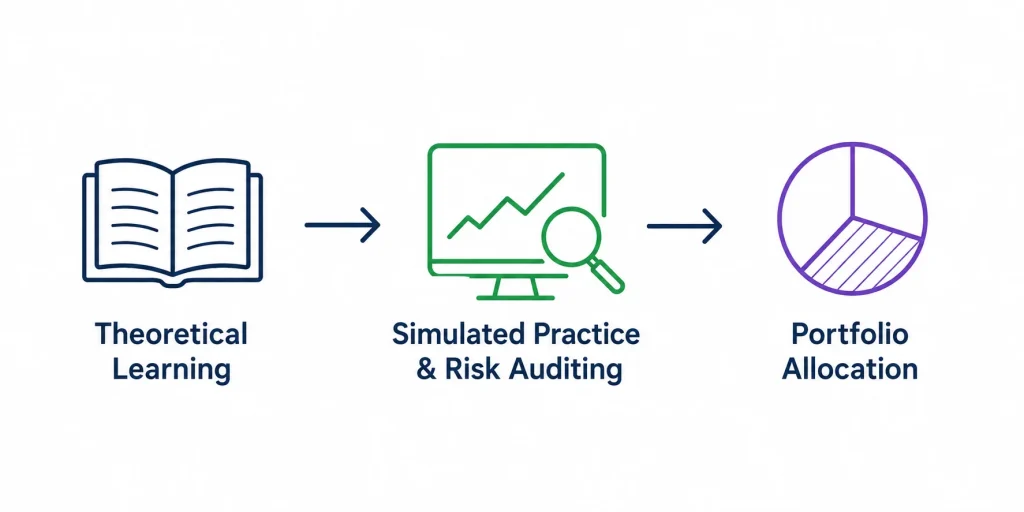
This framework allows individuals to prove discipline and consistency, devoid of the devastating financial penalties associated with the retail learning curve. It transforms market education from a spectator sport into an audited, meritocratic training ground.
The Democratization of Professional Skills
The broader macroeconomic implication of this shift is profound. Historically, advanced portfolio construction, macroeconomic interpretation, and complex risk-mitigation frameworks were the exclusive domain of professional Wall Street traders and investment banks.
Our age of information and tech is decoupling these high-level skills from traditional financial geography, and fast. When an aspiring market participant in Lagos, London, or Istanbul has access to the exact same risk metrics, institutional-grade tools, and structured educational guardrails, the traditional Wall Street advantage is degraded.
The future of financial participation belongs to those who view market navigation as a rigorous, performance-driven profession that demands the same discipline as any elite technical trade. Traditional financial literacy got people into the stadium; financial performance literacy is finally teaching them how to play the game.


You May Also Like

Netflix could turn NBC into its biggest bet yet — and this time, the math actually works

GE Aerospace Orders Jump 87% in Q1 2026: Should You Buy it Now?