

Grayscale Models AAVE Using Traditional Finance, Flags $175 Target
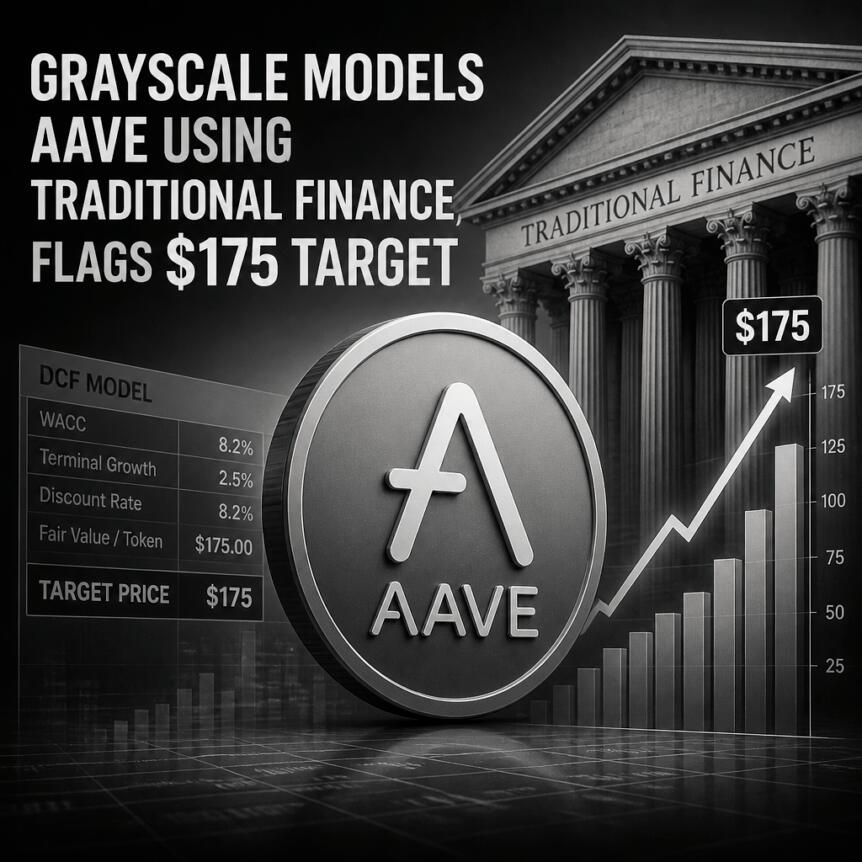
Grayscale Research is extending a familiar equity-and-banking playbook into decentralized finance, arguing that certain DeFi tokens can be valued using cash-flow and earnings frameworks. In a new report, the firm outlines a base-case scenario for Aave’s native token that places its one-year fair value in the $80 to $100 range, with a potential upside target of $175 under a more optimistic path.
The report also includes a forward-looking earnings estimate: Grayscale projects Aave could generate roughly $60 million in net income in 2026. It further highlights rapid growth in the underlying protocol’s economics—pointing to revenue rising more than sixfold between 2023 and 2025—while emphasizing that measurable revenue does not automatically translate into token value.
Key takeaways
- Grayscale estimates Aave’s one-year fair value at $80 to $100, with a $175 base-case upside scenario, using discounted cash flows and earnings-multiple approaches.
- Grayscale projects about $60 million in net income for Aave in 2026, while noting the protocol is estimated to run around a 50% margin.
- The valuation is grounded in token-level economics like lending activity, the GHO stablecoin, and institutional product growth—but fees do not always accrue directly to token holders.
- CoinShares is using similar long-term valuation models for Hyperliquid’s HYPE token and Ether, incorporating buybacks and “monetary role” and collateral effects for ETH.
Grayscale’s cash-flow framework for Aave
Grayscale’s central claim is that at least some DeFi tokens have revenue and earnings characteristics that can be assessed with valuation tools typically used for traditional financial institutions. For Aave, the firm applies a set of methods that includes discounted cash flows, earnings multiples, and comparisons with banks and fintech businesses.
Based on this analysis, Grayscale places Aave’s current fair value at $80 to $100. On Thursday, Aave traded around $75, according to CoinGecko, placing Grayscale’s range slightly above prevailing levels at the time of the report’s discussion.
Grayscale’s approach is designed to translate protocol-level performance into an investor-relevant view of expected returns. It argues that several streams tied to Aave could support future earnings growth: the lending engine that drives usage, the GHO stablecoin ecosystem, and what the report describes as institutional products aimed at bringing more traditional borrowers and capital allocators into the protocol.
Why “revenue” doesn’t automatically mean “token value”
One of the most important cautions in Grayscale’s report is that protocol revenue alone is not a guarantee for how much value ends up with token holders. In DeFi systems, fee flows can be distributed in multiple directions, and the smart-contract governance layer determines what happens after fees are generated.
Grayscale notes that transaction fees may be used for purposes such as paying liquidity providers, covering protocol operating costs, or being retained by a decentralized autonomous organization. Additionally, token holders generally do not have legally enforceable claims analogous to shareholders’ rights in a conventional corporation.
This distinction matters for investors because traditional valuation models rely on a clearer mapping between earnings and distributable value—something DeFi protocols may handle in different ways depending on governance and incentive design. In other words, a protocol can become more profitable while the token’s direct claim on those profits remains limited or delayed.
By explicitly raising this issue, Grayscale is effectively framing its valuation as a “best-effort” translation of DeFi economics into a cash-flow model—useful for structuring expectations, but still contingent on how fees and governance actually play out.
Economic drivers and the case for longer-term accrual
Grayscale ties its optimism to a set of measurable growth signals and ongoing sources of demand within the Aave ecosystem. The report emphasizes the scale-up in revenue between 2023 and 2025 and the protocol’s estimated 50% margin, both of which suggest improving efficiency in turning activity into earnings-like performance.
At the same time, it argues the token-level thesis is not only about lending volumes. It points to the GHO stablecoin and to institutional-facing offerings as potential levers for expanding usage and fee generation. If those segments continue to grow—and if governance results in value accrual that is meaningfully reflected in the token’s economics—the report’s valuation framework could remain directionally relevant.
Still, investors should note that Grayscale’s projected outcomes depend on assumptions about future fee generation, expense levels, and how the protocol directs fees over time. The report’s own warning about the difference between protocol earnings and distributable token value highlights where uncertainty can concentrate.
CoinShares extends the same idea to HYPE and Ether
Grayscale’s work aligns with a parallel trend: CoinShares has also begun applying long-horizon valuation models to crypto assets using economic drivers that can be measured from on-chain activity and protocol design.
CoinShares’ framework for Hyperliquid’s HYPE token and Ether (ETH) evaluates token value using protocol fees, buybacks, and other mechanisms that influence economic demand. For a 2031 base case, CoinShares values HYPE at $147 and ETH at $4,935. However, CoinShares cautions—implicitly via its modeling—that much of the projected ETH value comes from the token’s broader monetary and collateral role, not just cash-flow-like dynamics.
CoinShares describes Hyperliquid as a more direct example of token-level value accrual because 99% of protocol fees are used to buy back HYPE through its Assistance Fund. That kind of fee-to-buyback linkage more closely resembles the pathways investors expect from traditional financial arrangements where capital returns can be tied to earnings.
For Ether, CoinShares instead uses a “sum-of-the-parts” style framework that combines projected cash flows with a premium for its monetary and collateral functions. This reinforces a wider point about DeFi valuation: not all assets fit neatly into one template, and economic value might be expressed differently depending on how the asset is used across networks.
DeFi growth outlook meets token valuation debate
The push toward traditional valuation methods comes as parts of the financial industry anticipate faster expansion in tokenized markets and DeFi exposure. Standard Chartered, for example, has forecast that tokenized assets could lift DeFi assets to $2.7 trillion by 2030, and it has argued that Uniswap could become a major venue for tokenized trading activity—potentially aided by partnerships with traditional financial firms.
In that context, equity-style valuation approaches are gaining attention because they offer a structured way to translate protocol activity into expectations about earnings and long-term value. But the contrasting fee-allocation mechanics across DeFi protocols—where some designs distribute value more directly and others route it through liquidity incentives or governance—means that investors will likely need more than a single model to compare projects fairly.
As Grayscale and CoinShares publish more work using these frameworks, the key question for market participants will be whether projected economics consistently show up in token-level outcomes—particularly when fee flows, buyback mechanisms, and governance decisions determine how much value actually accrues to holders.
This article was originally published as Grayscale Models AAVE Using Traditional Finance, Flags $175 Target on Crypto Breaking News – your trusted source for crypto news, Bitcoin news, and blockchain updates.


You May Also Like

Top Analyst Presents 3 Major Historical References for XRP Price Rally

Genius Group (GNS) Stock Climbs 8% After Q1 Revenue Soars 171% and Returns to Profit

Stakestone (STO) Soars: Token Surpasses $1.14 After Stunning 367% Rally



