

BPO Philippines: Hourly billing in the era of agentic AI is dead. Here’s what replaces it
Agentic AI is now 10x faster and a fraction of the cost of human labor. A billing model built around hours of human time is no longer just inefficient — it is structurally incompatible with the technology your call center is already running.
 Here is a thought experiment every service buyer should be running in 2026. Your BPO partner in the Philippines deploys agentic AI across its tier-1 support workflows. Handle time drops 60%. Resolution rates climb to 92%. The same team that once processed 3,000 contacts a day now manages 9,000 — with better outcomes, lower error rates, and higher CSAT scores. The AI is working. Intelligence Arbitrage is real.
Now look at your invoice. You are still paying by the hour.
This is the Efficiency Paradox of the 2026/27 BPO market — and it is the most structurally corrosive problem in the Philippine call center industry. Hourly billing, in an era of agentic AI, is a tax on innovation. Every efficiency gain your BPO partner delivers through AI investment costs them revenue under a time-based model. The faster they solve your problems, the less they earn. The incentive architecture is not just misaligned — it is inverted.
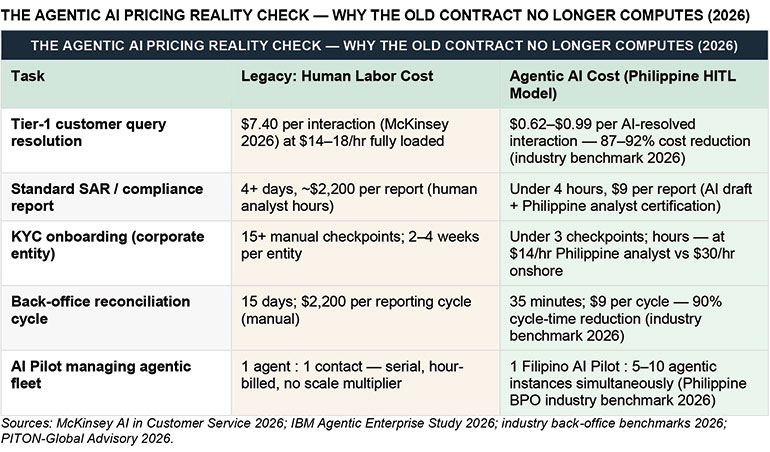 Why Is Hourly Billing a “Tax on Innovation” in the Age of Agentic AI?
Hourly billing is a tax on innovation because it prices labor, not outcomes — and by 2027, labor will no longer be the primary input in high-performing front- and back-office operations. Agentic AI will be. When a Filipino AI Pilot manages a fleet of 5–10 autonomous agents simultaneously, the economic unit of value is not an hour of work. It is a resolved interaction, a prevented churn event, a verified compliance decision, an upsold subscription. Pricing the hour when AI compresses hours to minutes creates what practitioners now call the Dead-End Billing Street: a contractual structure where neither party can capture the full value of AI investment.
The mathematics are unforgiving. A BPO that invests in agentic infrastructure — AI platforms, prompt engineering talent, knowledge base curation, governance architecture — and then bills its clients at the same hourly rate as a manual operation is destroying its own ROI. The more it invests in AI, the thinner its margins get under a time-based model. The rational response, if you are trapped in hourly billing, is to invest less in AI. And that is precisely what hourly contracts are inadvertently incentivizing across the Philippine BPO sector right now.
The market is already correcting. Productivity per agent is expected to increase 2–4x from AI augmentation, “fundamentally changing pricing models from per-full-time-equivalent to per-outcome, per-resolution, per-ticket” (global BPO industry analysis, January 2026). Leading agentic AI platforms have launched per-conversation pricing models in the range of $0.99–$2.00 per fully resolved interaction — explicitly framed as a replacement for the $30+ cost of a human-handled contact in Western markets. The precedent is set. The question for Philippine call center buyers in 2026 is not whether to move to Outcome-Based Pricing. It is how quickly they can structure the transition without destabilizing existing operations.
 According to John Maczynski, CEO of PITON-Global and the former Global EVP of the world’s largest contact center, “The era of ‘butts in seats’ pricing is over. What a client is purchasing from a Philippine operation in 2026 is not an hour of labor — it is operational hardening. The ability to resolve, retain, and recover at a speed and accuracy that no domestic team can match. Pricing that doesn’t reflect that value isn’t just unfair to the BPO. It’s strategically dangerous for the client, because it removes every incentive for the partner to invest in the AI infrastructure the client needs.”
What Is the Fairness Argument for Outcome-Based Pricing in Philippine Call Centers?
The fairness argument is simple and structurally sound: as AI compresses time, the value of outcomes expands. A customer retention call that once took 18 minutes and cost $4.20 at $14/hour now takes 4 minutes with AI assistance — but the value of retaining that customer has not changed. It may have increased, because the resolution was faster, the agent had richer context, and the follow-up was automated. If the BPO bills 4 minutes instead of 18, it captures 22% of the value it previously earned for delivering superior results. That is not a sustainable partnership model. It is a structural guarantee of under-investment.
Outcome-Based Pricing corrects this by anchoring the billing unit to the value created — the resolved interaction, the retained subscriber, the processed claim, the verified identity — rather than the time consumed. A higher per-outcome rate is not a price increase. It is a recalibration that makes innovation financially rational for both parties. When the BPO earns more per successful resolution, it has every incentive to invest in the AI infrastructure that increases resolution rates. When the client pays per outcome rather than per hour, they pay nothing for failed attempts, idle capacity, or AI transitions — only for delivered value.
 Ralf Ellspermann, CSO of PITON-Global and a 25-year veteran of Philippine BPO operations, puts it plainly: “The Philippines is not winning global contracts in 2026 because it has the cheapest labor. It is winning because it has developed something no algorithm can replicate at scale: the Empathy Moat. Filipino specialists bring a cultural warmth, a patience under pressure, and an emotional intelligence — what we call Malasakit — that transforms high-stakes customer interactions. The AI handles the velocity. The Filipino agent handles the truth. That combination commands a premium outcome rate. And it should.”
How Does the Transition from Hourly Billing to Outcome-Based Pricing Actually Work?
Transitioning from hourly to outcome-based pricing without operational disruption requires a phased approach — what PITON-Global’s advisory framework calls the Crawl, Walk, Run roadmap. Each phase has distinct financial structures, measurement requirements, and risk profiles. No enterprise should attempt to compress all three into a single contract cycle.
The BPOs that begin Phase 1 in 2026 reach full Value-Share by 2028. The ones that wait until 2027 arrive a year behind in a market where early movers are already capturing the premium contracts that outcome-based models unlock. The window is open. The competitive cost of inaction is compounding monthly.
Old Model vs. New Model: The Definitive Comparison
The Philippines as the Global Intelligence Arbitrage Hub
The BPO industry in the Philippines is not transitioning to Outcome-Based Pricing because it is fashionable. It is transitioning because the alternative — maintaining a billing architecture designed for 2014 while deploying technology built for 2026 — is a structural contradiction that eventually breaks one of the parties.
The buyers who remain on hourly contracts while their competitors move to outcome pricing are not being conservative. They are choosing to fund the slowest possible version of the operation available to them, at a time when the gap between outcome-aligned and hour-aligned outsourcing partnerships is widening by the quarter. Gartner projects that 40% of enterprise applications will include task-specific AI agents by the end of 2026. Every one of those agents needs a governance architecture, a human oversight layer, and an incentive model that rewards results. Hourly billing provides none of these.
The choice is not between old pricing and new pricing. It is between the outcome-velocity of 2027 and the hourly inertia of 2024. In 2026, that choice has a cost.
Maczynski is direct about what this means in practice: “Every client who stayed on hourly billing while we deployed agentic AI was essentially asking their BPO partner to take the financial hit for their modernization. That is not a partnership. Outcome-Based Pricing is how we build a model where both parties win when the AI works — and both parties have the incentive to make it work better every quarter. That is what Incentive Alignment looks like in practice.”
That incentive shift is not cosmetic. It is architectural. Under hourly billing, a BPO’s operational interest is to preserve headcount and process time. Under Outcome-Based Pricing, its operational interest is to maximize resolution velocity, minimize failure rates, and continuously improve the AI governance layer that makes outcomes possible. The pricing model does not just change how you pay — it changes what your partner optimizes for, every single day.
Ellspermann frames the bigger picture: “The Philippines wins on outcomes because our agents are not just executing tasks — they are governing AI systems, managing emotional escalations, and building the kind of brand trust that no algorithm will automate in our lifetimes. Price that by the hour, and you are telling the market you don’t understand what you’re buying. Price it by the outcome, and you are beginning to understand what Intelligence Arbitrage actually means.”
REALITY CHECK: WHO IS — AND ISN’T — READY FOR OUTCOME-BASED PRICING IN 2026
The Outcome-Based Pricing model described in this article is not a universal prescription. It is the logical endpoint for organizations that have already crossed the agentic AI production threshold — and that threshold has a non-negotiable prerequisite: data.
In practice, effective agentic AI deployment requires years of structured historical data — call recordings, resolved interaction logs, mapped customer workflows, labelled exception cases — to train, ground, and continuously improve the machine learning models that make autonomous resolution possible. Research from Bain & Company confirms that the biggest gap between AI pilot and production success is not model capability but the underlying data infrastructure. Organisations without that foundation do not get a slower AI — they get an unreliable one.
This means that, in 2026, Outcome-Based Pricing and the agentic AI workflows that justify it are largely the domain of large multinationals and globally operating enterprises — organizations with billions of data points accumulated across years of customer interactions, the in-house data science teams to structure and sanitize that data, and the IT infrastructure to integrate agentic systems into live production workflows.
For the majority of small and mid-sized enterprises (SMEs), the honest assessment is different. Without the historical datasets required to train effective domain-specific AI models, most SMEs are still 2–5 years from viable agentic AI deployment. For these organizations, the traditional outsourcing model — skilled Filipino specialists, hourly or task-based billing, proven quality frameworks — remains not just relevant but optimal. The Philippine call center industry serves both worlds: the AI-native enterprise seeking outcome-velocity, and the growth-stage SME that needs operational excellence delivered the conventional way, reliably and without the risk of premature automation.
The pricing model follows the data maturity, not the other way around. Organizations considering the transition to Outcome-Based Pricing should begin with an honest audit of their data infrastructure — not their ambition.
Spotlight is BusinessWorld’s sponsored section that allows advertisers to amplify their brand and connect with BusinessWorld’s audience by publishing their stories on the BusinessWorld Web site. For more information, send an email to online@bworldonline.com.
Join us on Viber at https://bit.ly/3hv6bLA to get more updates and subscribe to BusinessWorld’s titles and get exclusive content through www.bworld-x.com.


You May Also Like

Whale Alert for a Well-Established Altcoin! Unseen Data Since 2023 Emerges! Here Are the Details

USD/CAD Forecast: Goldman Sachs Predicts Canadian Dollar Resilience Amidst Looming Energy Shock




