Autonomous Enterprise Launch at SAP Sapphire 2026 Redefines Enterprise AI Operations
Autonomous Enterprise Launch at SAP Sapphire 2026 Signals SAP’s Shift Toward AI-Native Operational Execution
Enterprise software has spent decades optimizing workflows humans still had to manage manually. The Autonomous Enterprise Launch at SAP Sapphire 2026 suggests SAP believes the next phase of enterprise transformation is no longer about workflow visibility alone — it is about workflow autonomy.
At SAP Sapphire 2026 in Orlando, SAP introduced a broad autonomous enterprise architecture combining SAP Business AI Platform, SAP Autonomous Suite, and Joule Work. The announcement also expanded SAP’s strategic partnerships with Anthropic, Amazon Web Services, Google Cloud, Microsoft, NVIDIA, Palantir Technologies, Accenture, Mistral AI, Cohere, Parloa, Conduct, and n8n.
“For the mission-critical processes of our customers, ‘almost right’ just isn’t good enough.” — Christian Klein, CEO, SAP
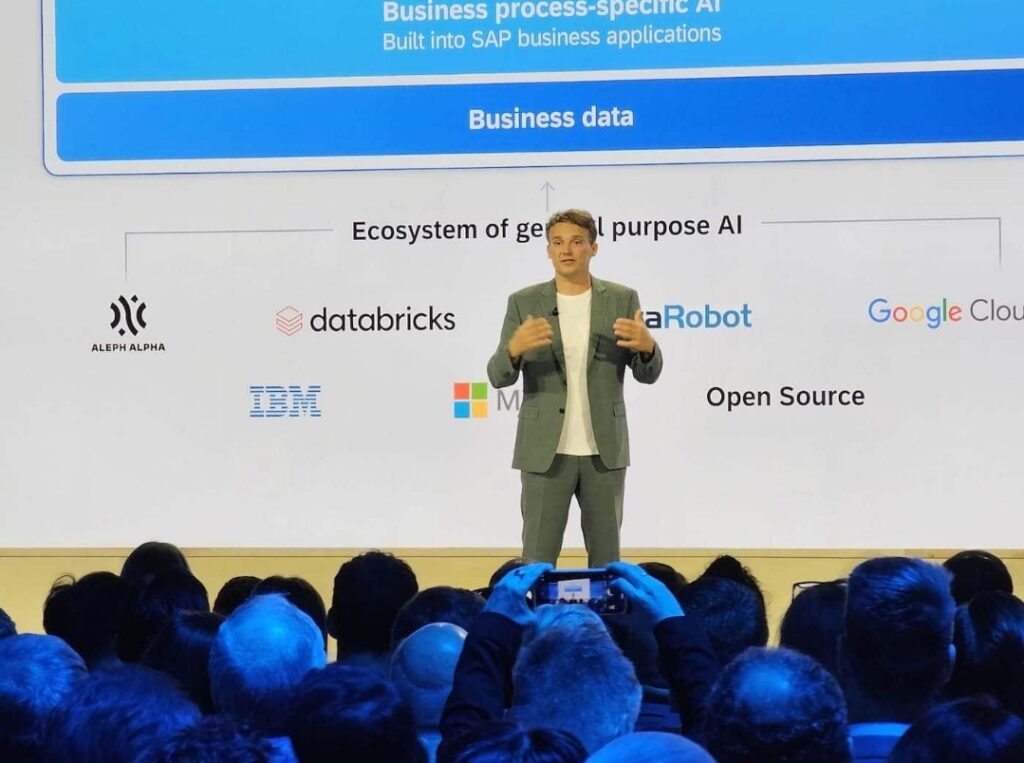
The statement captures the larger strategic narrative emerging across enterprise technology markets: enterprises are no longer looking for AI that simply assists employees. They increasingly want AI systems capable of executing business operations safely, accurately, and at scale.
Why the Autonomous Enterprise Launch at SAP Sapphire 2026 Matters
Enterprise AI has reached an inflection point. Many organizations deployed copilots, assistants, and predictive tools over the last two years, but operational bottlenecks remain stubbornly human-dependent.
This becomes critical when organizations attempt to scale AI beyond experimentation.
Traditional enterprise applications were designed around human navigation. Employees moved across dashboards, reconciled information between systems, and manually coordinated operational tasks. AI largely remained peripheral to execution.
SAP’s new architecture attempts to change that model by embedding autonomous agents directly into enterprise workflows.
At a structural level, SAP is trying to transform ERP systems from passive transactional environments into active operational intelligence systems.
The deeper implication is significant. Competitive advantage may increasingly belong to vendors capable of combining AI reasoning with operational context, governance, and workflow authority.
The Strategic Logic Behind SAP’s Autonomous Enterprise Push
The Autonomous Enterprise Launch at SAP Sapphire 2026 is fundamentally a control-layer strategy.
While many AI vendors compete on model capability, SAP is competing on process embeddedness. Its advantage comes from decades of integration into finance, procurement, HR, supply chain, and customer experience operations across global enterprises.
SAP Business AI Platform unifies:
- SAP Business Technology Platform
- SAP Business Data Cloud
- SAP Business AI
At the center sits the SAP Knowledge Graph, which structures relationships between business entities, workflows, operational dependencies, and governance rules.
This is where the shift occurs.
Enterprise AI systems fail when they lack operational context. Large language models may generate plausible outputs, but enterprise environments require traceability, compliance, and deterministic process execution.
Strategically, SAP is attempting to solve enterprise AI reliability through contextual grounding rather than model supremacy.
SAP’s Competitive Positioning Against Microsoft, Oracle, and Salesforce
The enterprise AI race is increasingly dividing into three strategic layers.
Infrastructure providers like Microsoft, Google Cloud, and Amazon Web Services dominate compute ecosystems and foundation model access.
Application-focused competitors like Oracle and Salesforce are embedding AI into enterprise workflows and customer operations.
Meanwhile, orchestration-focused players such as Palantir Technologies and ServiceNow focus heavily on operational intelligence coordination.
SAP’s differentiation lies in enterprise process depth.
By embedding AI directly into governed operational workflows, SAP is positioning itself not simply as an AI application vendor, but as an autonomous operational infrastructure provider.
How SAP’s Autonomous Architecture Works
SAP’s architecture consists of three interconnected operational layers.
SAP Business AI Platform
This layer provides the governed AI environment combining data infrastructure, AI tooling, semantic mapping, and orchestration governance.
“SAP Business AI Platform now unifies SAP Business Technology Platform, SAP Business Data Cloud and SAP Business AI into a single, governed environment.”
The SAP Knowledge Graph provides structured business semantics enabling AI agents to understand relationships between systems, entities, approvals, assets, suppliers, and operational dependencies.
SAP Autonomous Suite
SAP introduced more than 50 Joule Assistants capable of orchestrating over 200 specialized agents across enterprise workflows.
One example is the Autonomous Close Assistant, which automates journal entries, reconciliation, and error resolution to compress financial close cycles from weeks to days.
SAP also introduced Industry AI solutions for sectors including energy operations.
At SAP Sapphire, SAP showcased work with to reduce offshore wind turbine downtime through autonomous asset management scenarios.
Joule Work
Joule Work redesigns enterprise interaction models.
Instead of navigating software modules manually, employees specify business outcomes while AI agents orchestrate workflows in the background.
This becomes important because enterprise productivity friction increasingly comes from orchestration complexity rather than information scarcity.
The CX Implications of Autonomous Enterprise Operations
From a CX standpoint, autonomous enterprise systems affect both employee and customer experiences simultaneously.
Employees benefit from reduced workflow fragmentation and administrative burden.
Customers benefit from:
- Faster service resolution
- Reduced operational delays
- More proactive engagement
- Better personalization continuity
- Improved reliability
“Instead of navigating individual applications and entering data across several screens, users will now interact primarily with Joule.”
The deeper implication is that future customer experience quality may depend less on front-end interface design and more on operational orchestration intelligence behind the scenes.
Operationally, this translates to a future where AI coordination quality directly influences customer trust.
Why Governance and Trust Become Competitive Differentiators
SAP’s emphasis on governance is not accidental.
Autonomous enterprise systems create enormous operational leverage, but they also introduce new forms of systemic risk:
- AI hallucinations
- Governance failures
- Workflow opacity
- Compliance violations
- Cascading automation errors
This is why SAP’s partnerships matter strategically.
Anthropic contributes foundation model capability through Claude integration.
NVIDIA provides OpenShell secure runtime environments.
Parloa enables AI-powered service interactions.
Palantir Technologies and Accenture support migration and operational transformation initiatives.
This ecosystem strategy suggests SAP recognizes that enterprise autonomy cannot be achieved through isolated AI tooling alone.
The Organizational Reality Behind Autonomous Transformation
The Autonomous Enterprise Launch at SAP Sapphire 2026 also reveals a broader truth about enterprise AI transformation: technology implementation is the easier part.
The harder challenge is organizational redesign.
Enterprises pursuing autonomous operations will need:
- Data governance maturity
- Process harmonization
- Cross-functional orchestration models
- AI oversight frameworks
- Workforce adaptation strategies
SAP’s €100 million partner fund reflects this reality. Adoption barriers are not purely technical. They are operational, cultural, and organizational.
This becomes critical because autonomous enterprise transformation changes decision-making structures, operational accountability, and workflow ownership itself.
The Future of Enterprise Software May No Longer Be Software
The most important signal from SAP Sapphire 2026 may be philosophical rather than technical.
Enterprise software historically required humans to adapt themselves to systems. Autonomous enterprise architectures reverse that relationship by making systems dynamically orchestrate around human intent.
That represents a profound shift in enterprise operating models.
Strategically, SAP is betting that the future enterprise stack will be defined less by interfaces and more by orchestration intelligence.
If successful, autonomous enterprise platforms may eventually become invisible operational layers coordinating business activity continuously in the background.
And that could fundamentally redefine how enterprises think about productivity, customer experience, governance, and competitive advantage.
The post Autonomous Enterprise Launch at SAP Sapphire 2026 Redefines Enterprise AI Operations appeared first on CX Quest.


You May Also Like

Safe Havens Are Failing — Why Gold, Silver, and Crypto Are All Falling Together

Trump Lands In China—See Photos As He Prepares For Meeting With Xi