SpaceX shares extended their post-IPO pullback after the company disclosed plans to enter the bond market despite reporting more than $100 billion in cash and equivalents. The move highlights a key shift in investor focus. The first week after the IPO was dominated by scarcity, momentum, and index-inclusion speculation. Now the market is beginning to evaluate whether SpaceX's valuation can be supported by future cash flows, Starlink growth, and Starship execution rather than IPO enthusiasm alone.SpaceX shares extended their post-IPO pullback after the company disclosed plans to enter the bond market despite reporting more than $100 billion in cash and equivalents. The move highlights a key shift in investor focus. The first week after the IPO was dominated by scarcity, momentum, and index-inclusion speculation. Now the market is beginning to evaluate whether SpaceX's valuation can be supported by future cash flows, Starlink growth, and Starship execution rather than IPO enthusiasm alone.

SpaceX Slides as Debt Raise Revives the Valuation Debate

2026/06/23 15:40
3 דקת קריאה
למשוב או לפניות בנוגע לתוכן זה, אנא צור קשר איתנו ב crypto.news@mexc.com
תקציר חדשות
SpaceX shares extended their post-IPO pullback after the company disclosed plans to enter the bond market despite reporting more than $100 billion in cash and equivalents. The move highlights a key shift in investor focus. The first week after the IPO was dominated by scarcity, momentum, and index-inclusion speculation. Now the market is beginning to evaluate whether SpaceX's valuation can be supported by future cash flows, Starlink growth, and Starship execution rather than IPO enthusiasm alone.

SpaceX's Debt Offering Shows Growth Is Still Being Prioritized Over Profitability

SpaceX recently made waves by disclosing its first bond offering as a public company, with proceeds expected to refinance bridge loans and support long-term expansion initiatives. Interestingly, SpaceX disclosed over $100 billion in cash while launching a new debt offering following its record IPO, suggesting the debt raise is not driven by sudden liquidity concerns but by capital structure management and future investment needs.

This distinction matters heavily to the market because investors are no longer evaluating SpaceX as a newly listed stock benefiting simply from IPO scarcity. Instead, they are beginning to assess how much spending will be required to support massive Starship development, AI infrastructure ambitions, and the ongoing expansion of Starlink.

The market's immediate reaction suggests investors are becoming much more sensitive to valuation and capital allocation questions, especially after SpaceX briefly approached a staggering $3 trillion valuation following its Nasdaq debut.

The Market Is Repricing SpaceX From an IPO Story Into an Execution Story

SpaceX shares surged nearly 20% on their first trading day after pricing at $135 per share, turning the company into one of the largest publicly traded firms in the world. Since then, volatility has increased significantly as investors digest new information about earnings, spending plans, and future growth assumptions.

The emerging debate is no longer whether SpaceX is an exceptional company. The debate is whether investors are paying for today's business or for a future infrastructure platform that combines launch services, satellite connectivity, AI computing capacity, and potentially entirely new orbital industries.

That distinction becomes increasingly important when the company is still reporting net losses despite strong revenue growth. Recent disclosures showed annual revenue of approximately $18.7 billion alongside continued heavy investment spending. As a result, SpaceX's next challenge is proving its valuation after the IPO surge in the public markets.

For traders tracking these rapid price movements and looking to hedge positions, staying updated on SpaceX stock price and futures trading is becoming vital as the asset reprices.

Index Inclusion May Be the Next Major Catalyst

While the stock has pulled back from its post-IPO highs, institutional investors continue to watch potential index inclusion events closely.

Several major index providers have adopted accelerated rules that could allow SpaceX to enter key benchmarks much sooner than traditional IPOs. Investors are watching potential Nasdaq-100 inclusion as the next catalyst because it could generate massive, mechanical buying from passive funds and ETFs.

The next phase of trading may therefore be driven less by retail enthusiasm and more by institutional flows, index demand, and upcoming quarterly earnings disclosures.

The SpaceX Watchlist: 3 Critical Growth Catalysts for Traders

The key question for investors is whether SpaceX can transition from a scarcity-driven IPO winner into a company that consistently justifies its valuation through flawless execution.

Traders should keep a close eye on three specific metrics moving forward:

  • Starlink subscriber growth and profitability: Can the satellite internet arm maintain its growth trajectory and improve profit margins?
  • Starship development milestones and launch cadence: Will regular, successful launches scale up fast enough to meet commercial demand?
  • AI infrastructure spending and monetization: How heavily will SpaceX invest in AI, and what is the timeline for seeing a return on that capital?

The stock's early volatility suggests that investors are beginning to demand hard evidence rather than exciting narratives. The IPO proved there was enormous demand for SpaceX shares. The next challenge is proving that long-term growth can support one of the market's most ambitious valuations.

מאמרים שנכתבו על ידי צוות העריכה של MEXC News נועדו למטרות מידע כללי בלבד ואינם מהווים ייעוץ פיננסי, ייעוץ השקעות או ייעוץ מסחר. שוקי הקריפטו תנודתיים מאוד, לכן יש לבצע מחקר עצמאי ולאמת את המידע באופן עצמאי לפני קבלת החלטות פיננסיות. התוכן הופק בהתאם ל מדיניות העריכה שלנו, ו-MEXC אינה נושאת באחריות להפסדים שנגרמו כתוצאה מהסתמכות על תוכן זה. לדיווח על הפרת זכויות יוצרים או זכויות של צד שלישי, יש לפנות לכתובת crypto.news@mexc.com.

אולי תאהב גם

Breaking: Samsung Dramatically Postpones Massive Strike, Korean Chip Stocks Surge, MEXC Launches Samsung and SK Hynix Futures

Breaking: Samsung Dramatically Postpones Massive Strike, Korean Chip Stocks Surge, MEXC Launches Samsung and SK Hynix Futures

In the late hours of May 20, 2026, Samsung Electronics reached a tentative wage agreement with its union, averting an originally planned 18‑day strike. On May 21, the KOSPI surged 8.42%, with Samsung Electronics closing up 8.51% at an all‑time high and SK Hynix rising 11.17%. Both companies posted record first‑quarter earnings: Samsung reported revenue of 133.9 trillion won, while SK Hynix surpassed 50 trillion won in quarterly revenue for the first time, driven by strong HBM demand. Positive catalysts also included NVIDIA’s earnings report and South Korean semiconductor policy initiatives. MEXC has launched perpetual contracts for Samsung and SK Hynix, supporting USDT trading and 24/7 operation.
לַחֲלוֹק
MEXC NEWS2026/05/21 17:15
SWIFT Blockchain Ledger Goes Live: Is Bank Money Going 24/7?
SWIFT Blockchain Ledger Goes Live: Is Bank Money Going 24/7?

SWIFT has moved its blockchain strategy from testing into live banking activity. Standard Chartered and HSBC completed the first live interbank cross-border transaction using the SWIFT blockchain ledger on August 19, 2026, connecting tokenized deposit infrastructure at two regulated banks. Just one week later, UOB and HSBC completed live Hong Kong dollar transactions on the same infrastructure, showing that the project is already expanding beyond a single demonstration
לַחֲלוֹק
MEXC NEWS2026/08/31 16:27
Micron Q3 2026 Earnings Results: $41.46B Revenue Reprices the AI Memory Trade

Micron Q3 2026 Earnings Results: $41.46B Revenue Reprices the AI Memory Trade

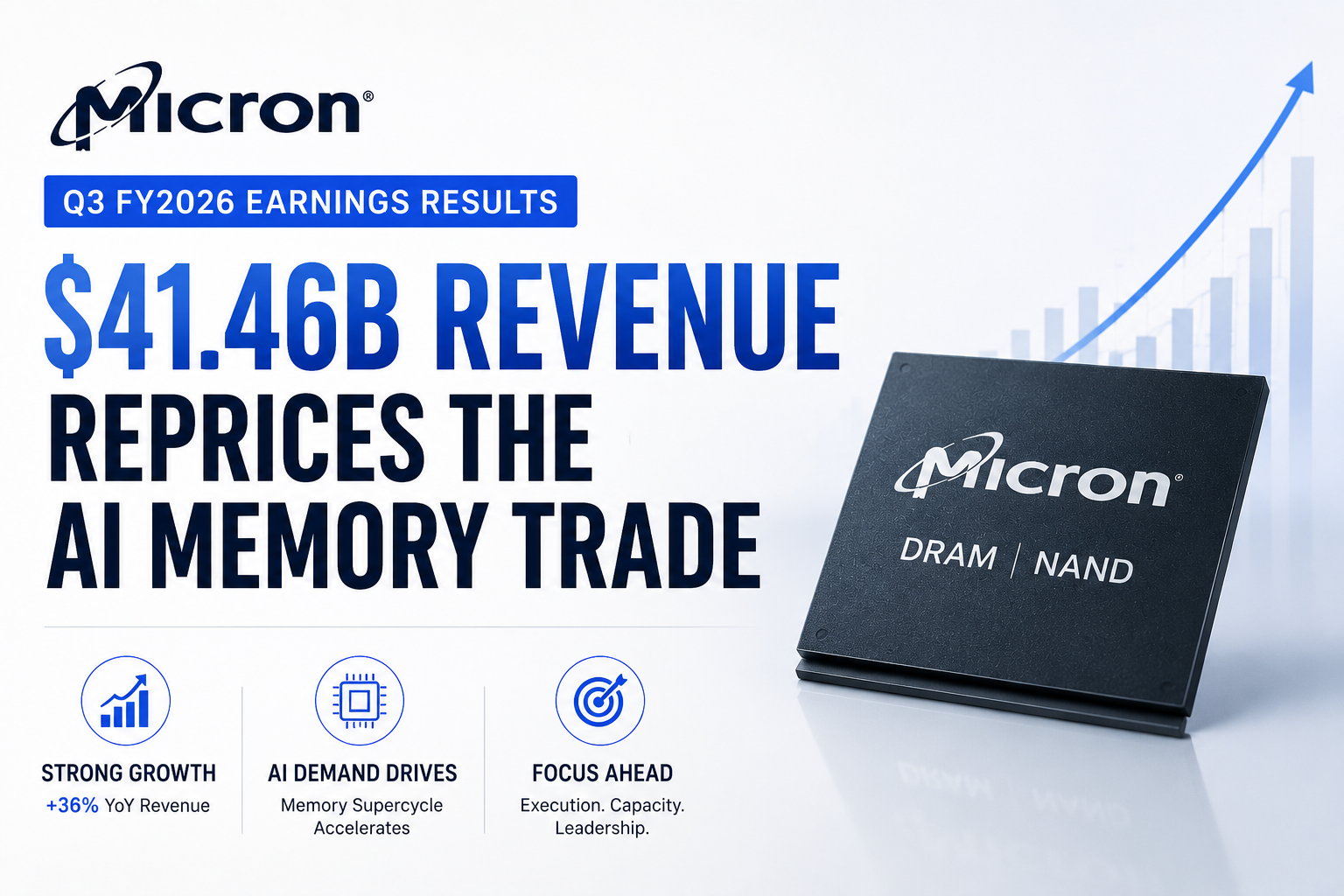
Micron Technology reported record fiscal Q3 2026 earnings results, with revenue reaching $41.46 billion, up from $9.30 billion a year earlier, as demand for AI-related memory and storage continued to exceed supply. Non-GAAP diluted EPS rose to $25.11, while non-GAAP gross margin expanded to 84.9%. The company also guided for about $50 billion in fiscal Q4 revenue, plus or minus $1 billion. This is not ordinary earnings news because Micron is no longer being judged only as a cyclical DRAM and NAND supplier. The latest Micron results suggest the market is repricing memory as a strategic bottleneck in the AI infrastructure buildout. High-bandwidth memory, data-center DRAM, enterprise SSDs, and long-term customer supply agreements are reshaping how investors think about Micron’s role in the AI supply chain.
לַחֲלוֹק
MEXC NEWS2026/06/25 09:48