Wall Street AI Adoption Nears 85% — But Where Are the Returns?
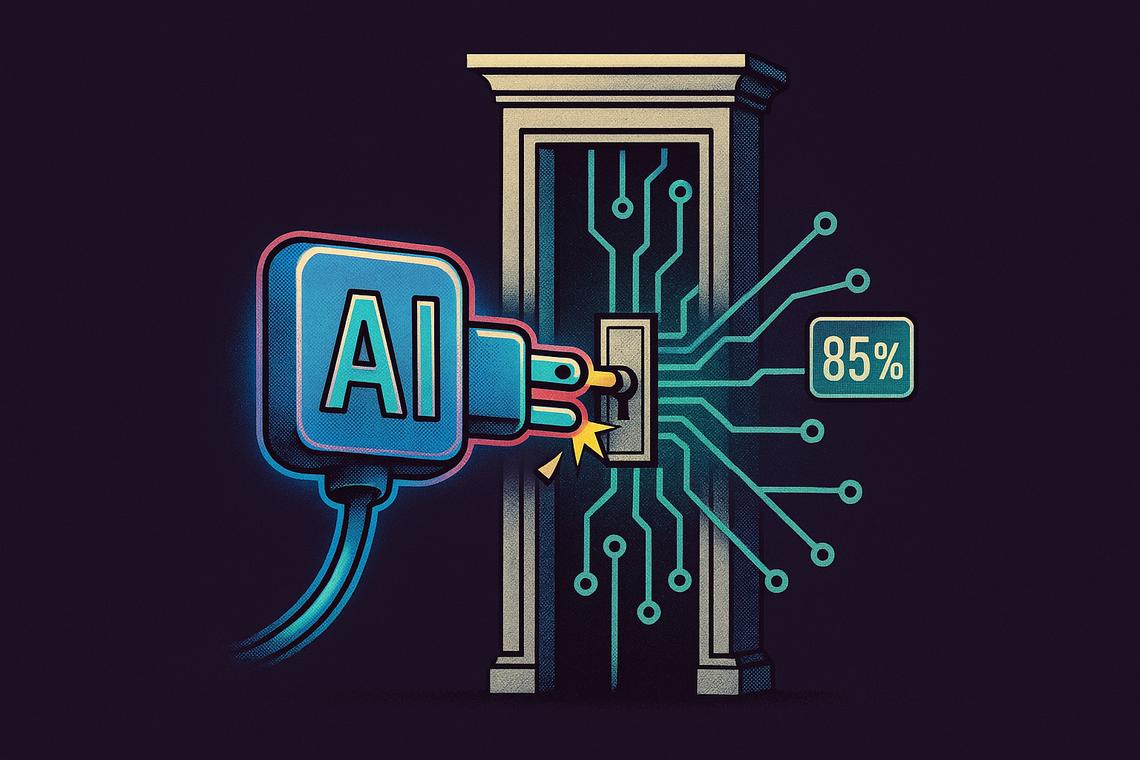
Something fundamental is changing on Wall Street, and it goes well beyond spreadsheets and algorithms. Wall Street AI adoption has accelerated to a point where it is no longer an experiment — it is becoming the operating standard. With 85% of financial institutions expected to incorporate AI by 2025, the question is no longer whether the financial sector will embrace these tools, but how deeply, and at what cost.
Key takeaways
- 85% of financial institutions are expected to adopt AI by 2025, signaling a sector-wide transformation.
- Hedge funds and wealth managers are deploying AI primarily to sharpen decision-making and uncover market opportunities.
- AI adoption on Wall Street signals a strategic operational shift, not just a technology upgrade.
- Concerns persist around AI accuracy and costs in high-stakes financial environments.
- Rising AI integration is reshaping investor sentiment toward AI companies, including Anthropic.
Wall Street’s Growing Reliance on AI for Investments
The financial industry’s pivot toward AI-driven strategies is more than a trend — it reflects a structural rethinking of how markets are analyzed, how capital is allocated, and how risk is priced. Hedge funds and wealth managers are at the forefront, deploying AI to process vast volumes of data, identify patterns invisible to human analysts, and execute decisions faster than any traditional model allows.
The scale of expected adoption is striking. An estimated 85% of financial institutions plan to integrate AI into their operations by 2025. That figure suggests the window for firms sitting on the sidelines is closing rapidly.
AI’s role in improving investment decision-making
At its core, the appeal of AI in finance comes down to decision quality and speed. Markets generate enormous amounts of information — earnings reports, macro signals, sentiment data, geopolitical shifts — and AI systems can synthesize those inputs in real time, far faster than human teams. The goal is straightforward: improve returns by reducing blind spots and reacting to opportunity faster than the competition.
This isn’t just about automating routine tasks. The more ambitious use cases involve AI systems that identify non-obvious correlations across asset classes, stress-test portfolios under thousands of simulated conditions, and flag early warning signals before they surface in price action.
Expected widespread AI adoption by financial institutions
The 85% adoption figure is a signal the entire industry is watching. When nearly nine in ten institutions are moving in the same direction, it stops being an edge and starts being the baseline. Firms that delay risk falling structurally behind — not just in performance, but in the quality of risk management and client servicing they can offer.
Strategic Shift in Financial Sector Operations
This level of AI integration represents a genuine operational transformation. It is not simply layering a new tool onto existing workflows — it is redesigning how financial firms function at their core. Research from the broader AI adoption landscape reinforces this point: leaders who treat AI as a bolt-on to legacy processes tend to encounter friction and poor outcomes, while those who redesign workflows around the technology’s capabilities gain compounding advantages.
AI adoption as a transformative operational change
For financial institutions, the transformation is touching everything from front-office trading strategies to back-office compliance and client communication. The firms moving most aggressively aren’t just deploying AI in isolated pockets — they are embedding it across functions, which changes how teams are structured, how talent is hired, and how decisions get made at every level.
Evidence from other industries underlines a useful parallel. A study by Ramp and Revelio Labs, which tracked 22,000 US firms, found that the highest-intensity AI adopters — spending around $34 per employee per month on AI — actually grew headcount by approximately 10.2% in the two years after adopting the technology, with entry-level hiring rising 12% in that period. In other words, AI integration at scale tends to expand organizations rather than immediately shrink them, at least in the early phases.
Impact on hedge funds and wealth managers
For hedge funds, AI offers sharper alpha generation — the ability to find returns that the market hasn’t already priced in. For wealth managers, the focus is different: AI enables more personalized client strategies at scale, automates compliance monitoring, and strengthens the advisory layer without proportionally increasing headcount. Both use cases reflect the same underlying logic — more analytical power per dollar spent on talent and infrastructure.
Market Implications and Perceptions of AI Companies
Wall Street’s AI adoption is not just transforming internal operations — it is also shaping how investors value the companies building the technology. Market pricing suggests that rising AI integration across financial services is influencing investor sentiment toward AI development firms, including Anthropic.
Influence of AI integration on market pricing
As financial institutions deepen their AI commitments, capital flows toward the companies supplying the infrastructure, models, and platforms that make it possible. Every major bank or asset manager that publicly commits to an AI strategy adds credibility to the sector and can drive rerating of the companies they are partnering with or procuring from.
Investor sentiment towards companies like Anthropic
Anthropic sits at a particularly interesting intersection here. As a leading AI developer, its perceived value is closely tied to the pace of enterprise adoption across high-value sectors. When Wall Street accelerates its AI buildout, firms like Anthropic benefit both from direct business and from the broader market narrative that institutional demand for advanced AI is durable and growing. That dynamic feeds into funding rounds, valuations, and strategic partnerships in ways that are difficult to disaggregate from pure fundamentals.
Concerns and Risks Surrounding AI Adoption in Finance
The optimism is real, but so are the friction points. Concerns about AI accuracy and cost in high-stakes financial environments remain significant and are unlikely to disappear quickly.
Cost and accuracy challenges of AI in high-stakes environments
The cost of deploying enterprise-grade AI — model licensing, infrastructure, data pipelines, compliance frameworks — is not trivial, especially for mid-sized institutions without the balance sheets of the largest banks. And in finance, where a flawed model can trigger outsized losses or regulatory scrutiny, the bar for accuracy is exceptionally high. AI systems that perform well in backtests can behave unpredictably during market stress events that fall outside their training data.
There is also a subtler risk: overconfidence in AI outputs. When a model’s recommendations are opaque or difficult to audit, risk managers may struggle to distinguish genuine signal from noise — or worse, may not realize they are relying on a flawed inference until real capital has been deployed on it.
Potential impact of regulatory and technological setbacks
Regulatory frameworks around AI in finance are still catching up with the technology’s pace. Shifts in policy — around explainability requirements, data usage, or liability for algorithmic errors — could force costly system redesigns or create compliance uncertainty that slows adoption. Technological setbacks, including model failures or high-profile AI-linked losses at a major institution, could dampen sentiment and trigger industry-wide reassessment. Neither risk is inevitable, but both are live.
What to Watch: Indicators for AI’s Financial Market Trajectory
The near-term trajectory of AI on Wall Street will be shaped by a handful of concrete signals worth tracking closely.
Key indicators include:
- Announcements from major AI firms around new models, enterprise pricing, and financial sector partnerships
- Funding rounds for AI infrastructure companies, which reflect institutional confidence in long-term demand
- Regulatory developments, particularly guidance from bodies like the SEC or Bank of England on AI explainability and algorithmic accountability
- Evidence of productivity gains — or the absence of them — as firms begin to report on AI’s measurable impact on performance
That last point deserves attention. Research has identified what some are calling a “productivity paradox”: workers using AI tools complete individual tasks faster, but those gains have not yet consistently translated into higher overall productivity or profitability at the firm level. If that gap persists, it could force a recalibration of expectations — not about whether AI belongs in finance, but about the timeline and shape of the returns.
The institutions that navigate this gap most effectively — building the infrastructure, the talent, and the governance frameworks to turn AI capability into measurable performance — will likely define what competitive advantage in finance looks like for the next decade. Those that treat AI as a headline strategy rather than a genuine operational commitment may find the 85% adoption figure tells only half the story.
FAQ
Why is Wall Street adopting AI for investment strategies?
Wall Street is adopting AI to enhance decision-making and identify lucrative opportunities within financial markets. AI systems can process large volumes of data in real time, uncover non-obvious patterns, and react to market developments faster than traditional analytical methods allow.
What percentage of financial institutions are expected to use AI soon?
85% of financial institutions are expected to incorporate AI by 2025, according to current projections. This near-universal adoption rate signals that AI integration is rapidly becoming the industry baseline rather than a competitive differentiator.
What risks are associated with AI adoption in finance?
The main concerns involve AI’s costs and accuracy in high-stakes financial decisions. Deploying enterprise AI requires significant investment, and models that underperform during market stress events can cause serious losses. Regulatory uncertainty and potential technological setbacks add further complexity to the adoption process.
How does AI integration affect perceptions of AI companies like Anthropic?
Market pricing suggests that as AI integration deepens across financial services, investor sentiment toward AI development companies — including Anthropic — becomes more favorable. Institutional demand for advanced AI tools strengthens the strategic and commercial position of firms building the underlying technology.
Article produced with the assistance of artificial intelligence and reviewed by the editorial team.


You May Also Like

Trump fesses up as reporter accuses him of 'profiting off presidency'

MemeCore Price Prediction: Can M Extend Its 45% Rally?