What’s Going On With Ethereum And Why Is Price Moving This Way?
Ethereum has been moving sideways in recent weeks, leaving traders questioning why momentum keeps stalling despite multiple upward pushes. According to an analysis shared by an analyst on X, the answer lies in a specific technical level that the asset has repeatedly failed to reclaim.
Ethereum’s $2,450 Barrier
The recent price behavior of Ethereum can be traced to the market’s interaction with a resistance area near $2,450. In early May, the analyst outlined that this level functioned as a decisive confirmation point for bullish continuation. The structure suggested that if Ethereum could move above $2,450, even briefly, it would signal that the breakout from the current range was genuine.
In the chart shared at the time, the region around this price was highlighted as a critical reclaim zone. The analysis argued that once the price clears such a level, it becomes a strong directional signal for traders. Because the level lacked complicated confirmation requirements, even a quick move above it would have been enough to validate bullish momentum.

However, until that threshold was crossed, the analyst maintained a cautious stance. The reasoning was straightforward: markets often approach major breakout levels only to reverse if buying pressure cannot sustain the move. The repeated hesitation around $2,450 suggested that the upward move could still fail if the market could not overcome that barrier.
This framework also tied Ethereum’s behavior closely to that of Bitcoin. The analyst mapped the $2,450 level on Ethereum as roughly equivalent to a key resistance zone around $81,000 on Bitcoin. If Ethereum confirmed a breakout above that point, it would likely strengthen confidence across the broader crypto market.
Rejection Signals Downside Risk
Days later, price action delivered the scenario the analyst had warned about. Ethereum approached the resistance zone but failed to convincingly move above it. Although the market tested the area, it never produced the decisive wick above $2,450 that was required to confirm a reclaim.
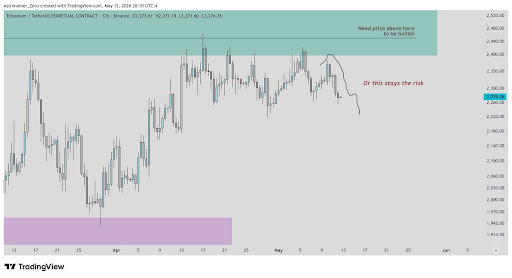
Once the rejection occurred, the bearish scenario outlined in the earlier analysis began to unfold. Ethereum started to move lower, reinforcing the idea that the resistance had not been broken. The follow-up chart showed price drifting away, with the projected path pointing toward further downside if the market continued to lose momentum.
The outcome was also linked to Bitcoin’s movement. Because Ethereum failed to confirm strength at the crucial level, it suggested weakness across the broader market structure. That correlation was used to frame a short trade idea on Bitcoin around $82,300, based on the expectation that both assets would move lower together.
Technically, Ethereum remains in a distribution phase below resistance and is struggling to generate enough volume for a breakout. Until it decisively reclaims the $2,450 level, the analyst’s framework suggests the market could remain vulnerable to further pullbacks. In practical terms, the $2,450 level has become the dividing line between a renewed breakout and continued downside risk.


You May Also Like

Zero Outflows. $123M Locked. The Chainlink ETF Story Nobody Is Talking About

US Dollar Surges as Hawkish Fed Repricing Drives Breakout, Says ING