Circle Stock Fell 18% After a Rival Stablecoin Launched: Is CRCL a Buy at $62?
Key Stats for Circle Stock
- Current Price: $62.63
- Target Price (Mid): ~$290
- Street Target: ~$143
- Potential Total Return: ~363%
- Annualized IRR: around 41% / year
- Max Drawdown: (78.63%) on February 5, 2026
Now Live: Discover how much upside your favorite stocks could have using TIKR’s new Valuation Model (It’s free) >>>
What Happened?
Circle Internet Group (CRCL) spent two years telling investors its moat was so wide that no serious institution would ever build a rival. On June 30, more than 140 of them did exactly that, and the stock fell 17.55% to $62.63 in a single session. That was one of the sharpest one-day drops since Circle went public, and it dragged the stock to a roughly four-month low.
Two things hit at once, and both matter. The trigger investors fixated on was the launch of Open USD (OUSD), a dollar-pegged stablecoin from a new consortium called Open Standard. The same day, FTSE Russell’s annual reconstitution removed Circle from several Russell growth indexes, which forced mechanical selling from index-tracking funds. The index removal amplified the move, but the OUSD news is what reset the thesis.
What made OUSD different was the backer list, not the coin. Stripe, Visa, Mastercard, BlackRock, BNY, and Coinbase all signed on, and several of those names are Circle’s own reserve, custody, and distribution partners. When the companies that help you distribute your product help launch a competitor, the market notices.
The economics are the real strike. USDC generates almost all of Circle’s revenue from interest earned on the U.S. Treasuries that back the stablecoin, and Circle keeps that reserve income for itself. Open USD flips the model: it charges no minting or redemption fees, sets no volume caps, and distributes most of the reserve yield back to the partners who route the flows. That structure aims directly at the reason many businesses tolerate USDC’s fees today.
The bulls and bears are now fighting over one question, and it is genuinely unresolved. Is a committee-run stablecoin backed by 140 competing firms a real threat, or is it the latest in a long line of consortium coins that never shipped at scale? The answer decides whether $62 is a broken moat or a mispriced entry.
What the Bears See, and What the Bulls See Back
The bear case is not complicated. Circle paid Coinbase $907.9 million in 2024 to distribute USDC, per figures disclosed in its filings and investor relations materials, and that agreement comes up for renewal in August 2026. Coinbase backing a yield-sharing rival two months before that negotiation is a pointed move. If the distribution layer, the exchanges, processors, and wallets that actually move stablecoin volume, start steering flows toward a coin that pays them, USDC’s growth and reserve income both come under pressure at once.
The bulls have a specific rebuttal, and it comes with names attached. William Blair reaffirmed its Outperform rating on the news, with analysts Andrew Jeffrey and Adib Choudhury arguing that Circle stays well-positioned because of its first-mover advantage, deep liquidity, and established payments infrastructure. Clear Street managing director Owen Lau called the roughly 16% selloff an overreaction in comments to CoinDesk, and pointed to Paxos’s Global Dollar Network (USDG), another consortium coin that shares reserve income and has grown to only about $3 billion in supply since late 2024, still a fraction of USDC’s roughly $73 billion. Ark Invest’s Lorenzo Valente was blunter, saying he would bet on operators who can ship products on their own over a board that has to ask 500 rivals for permission.
CEO Jeremy Allaire pre-argued this exact fight five weeks before it started. At the Bernstein Strategic Decisions Conference on May 28, 2026, he framed stablecoins as networks rather than coins: “If you’re a major company and you are deciding what stablecoin network am I going to use? USDC is fundamentally the only real choice that you have.” That claim matters now because OUSD is the test of it. Allaire also noted that after the GENIUS Act passed, a year of rumors about Meta and Amazon launching stablecoins produced “the opposite” of defection, with the biggest firms choosing USDC rather than building their own. OUSD is the first serious challenge to that pattern.
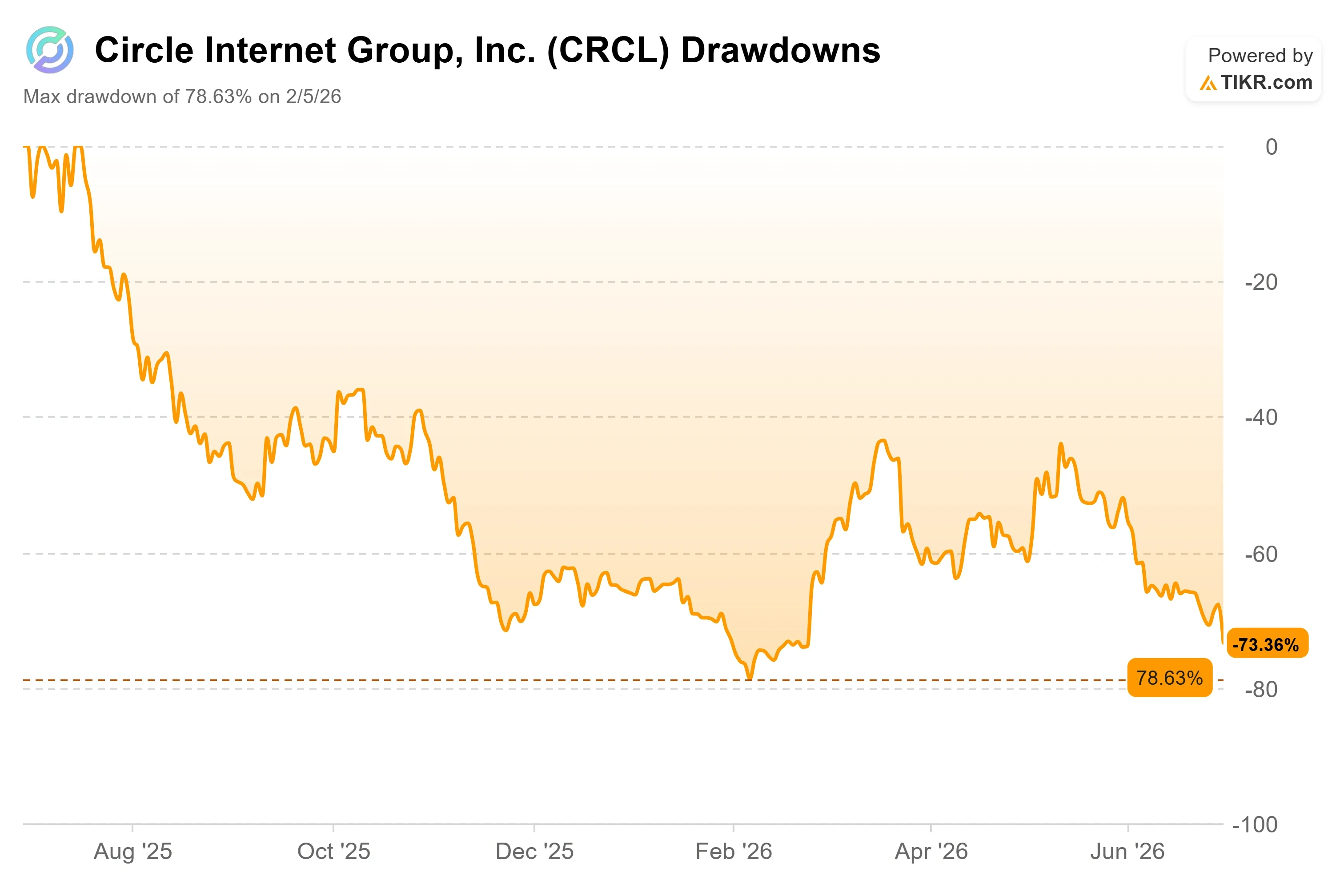 Circle Drawdowns (TIKR)
See historical and forward estimates for Circle stock (It’s free!) >>>
The Business Underneath the Noise Is Still Growing
The selloff has almost nothing to do with Circle’s operating trajectory, which is the part that makes this interesting. In Q1 2026, revenue and reserve income came in at $694.13 million, up around 20% year over year, though it missed estimates by 2.90% and fell from $770.23 million in the prior quarter. USDC circulation ended the quarter at roughly $77 billion, up 28% year over year, and on-chain USDC transaction volume surged 263% to $21.5 trillion. Adoption is not the problem. The reserve return rate is.
That is the real tension in the stock, and OUSD sharpens it rather than creating it. Most of Circle’s revenue is interest on reserves, so income falls when the Federal Reserve cuts rates, and the sequential revenue decline came even as transaction volume exploded. The usage metrics look like a category winner. The income statement looks like a rate trade. OUSD adds a third worry: even if usage keeps compounding, a yield-sharing rival could force Circle to give away more of the reserve income it does earn.
There is a peer datapoint here that cuts against the panic. The stablecoin market has grown past $300 billion, with Tether’s USDT near $145 billion and USDC near $73 billion, and Tether CEO Paolo Ardoino greeted OUSD with a shrug on X: “Welcome OUSD. Player 2 has entered the game.” When the market leader treats a 140-firm launch as background noise, it is at least a signal that incumbency in stablecoins is stickier than a single announcement suggests. The economic moat question is exactly what the next two quarters will answer.
 Circle Revenues (TIKR)
See how Circle performs against its peers in TIKR (It’s free!) >>>
TIKR Advanced Model Analysis
- Current Price: $62.63
- Target Price (Mid): ~$290
- Potential Total Return: ~363%
- Annualized IRR: ~41% / year
 Circle Advanced Valuation Model (TIKR)
See analysts’ growth forecasts and price targets for Circle stock (It’s free!) >>>
From today’s $62.63, that mid-case target of around $290 implies a potential total return of around 363% over roughly four and a half years. The extended model runs the same assumptions out to 2034, where the mid case reaches around $453 for an IRR of around 26%, a useful reminder that the near-term return is front-loaded by how far the stock has already fallen.
The mid case rests on two revenue CAGR drivers: continued USDC circulation growth as institutional and cross-border adoption deepens, and the ramp of non-reserve revenue from the Circle Payments Network and the Arc blockchain. The model assumes a revenue CAGR of around 20% and a net income margin of around 15% through the forecast period. The margin driver is operating leverage, the ability to convert surging transaction volume into revenue that grows faster than the cost base. The primary risk is the reserve model itself: falling interest rates and the OUSD threat both compress the yield Circle keeps per dollar of USDC.
The upside is that network effects let Circle turn its transaction-volume lead into durable, rate-independent platform revenue and re-rate as software rather than a rate trade. The downside is that competition and Fed cuts squeeze it into a low-margin payments utility that never justifies the multiple.
Conclusion
The number to watch is not the next earnings line. It is the Coinbase distribution agreement, which renews in August 2026. That renewal is the first hard test of whether OUSD’s economics are already reshaping Circle’s own contracts. Good looks like a renewal on terms that hold or improve Circle’s revenue-less-distribution-cost margin above 41%, the level it hit in Q1. Bad looks like Coinbase using OUSD as leverage to extract a larger share, which would confirm the bear thesis that the distribution layer now has the upper hand.
Then comes Q2 2026 earnings on August 18. If USDC circulation pushes back above $80 billion and the reserve-less-distribution margin holds, the adoption story is outrunning both the rate drag and the competitive noise. If circulation stalls near $77 billion and margin slips, the stock stays a rate trade with a new rival attached. August decides which story this is.
See what stocks billionaire investors are buying so you can follow the smart money with TIKR.
Should You Invest in Circle?
The only way to really know is to look at the numbers yourself. TIKR gives you free access to the same institutional-quality financial data that professional analysts use to answer exactly that question.
Pull up Circle, and you’ll see years of historical financials, what Wall Street analysts expect for revenue and earnings in the quarters ahead, how valuation multiples have moved over time, and whether price targets are trending up or down.
You can build a free watchlist to track Circle alongside every other stock on your radar. No credit card required. Just the data you need to decide for yourself.
Analyze Circle on TIKR Free →
Looking for New Opportunities?
- See what stocks billionaire investors are buying so you can follow the smart money.
- Analyze stocks in as little as 5 minutes with TIKR’s all-in-one, easy-to-use platform.
- The more rocks you overturn… the more opportunities you’ll uncover. Search 100K+ global stocks, global top investor holdings, and more with TIKR.
Disclaimer:
Please note that the articles on TIKR are not intended to serve as investment or financial advice from TIKR or our content team, nor are they recommendations to buy or sell any stocks. We create our content based on TIKR Terminal’s investment data and analysts’ estimates. Our analysis might not include recent company news or important updates. TIKR has no position in any stocks mentioned. Thank you for reading, and happy investing!


You May Also Like

Bayern sign Morocco midfielder Saibari on five-year deal

68% of global BTC miners came from the U.S., Russia, and China, Q1 2026