

Google Searches Could Expose Users to Crypto Wallet Risks
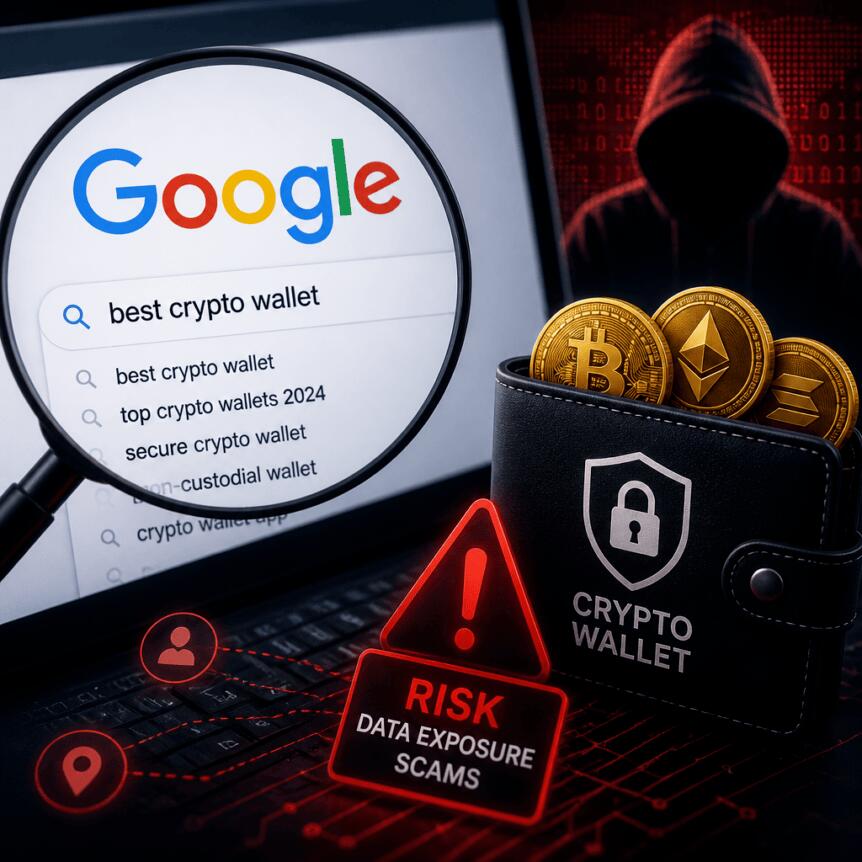
Search engines have long been treated as neutral starting points for online activity, but crypto security experts are increasingly warning that results pages themselves can be weaponized. Rather than hacking wallets through malware or stolen credentials, scammers can exploit the way users find and validate sites—turning search queries and one careless click into an attack sequence.
Recent reporting highlights how fake sponsored listings and cloned interfaces can trick users into approving token permissions that later enable fund withdrawals. As these scams evolve, the biggest risk may no longer be “breaking into” a system—it may be persuading a user to take the exact action attackers need.
Key takeaways
- Search results and sponsored ads can serve as a direct entry point for crypto phishing and approval-based theft.
- These attacks often succeed without malware or seed-phrase theft—victims authorize malicious actions themselves.
- Hardware wallets protect keys but can’t reliably judge whether an approval is in the user’s best interest.
- Even users who avoid paid ads may still be exposed via SEO poisoning, typosquatting, and lookalike domains.
- Reducing risk is largely about user workflow: bookmark official sites, scrutinize URLs, and slow down transaction approvals.
Search results are now part of the crypto threat model
Traditional crypto security guidance tends to emphasize protecting seed phrases, using hardware wallets, enabling multi-factor authentication, and avoiding suspicious links. That focus remains important—but it can miss a growing weakness: the search engine path that gets users to the wrong place in the first place.
For years, platforms like Google have been seen as reliable gateways to information. Users often assume the listings at the top of a results page are trustworthy, especially when a “Sponsored” label appears. Yet search engines are designed to deliver results that match user intent and monetize visibility—conditions that scammers understand well.
Because crypto transactions can move value instantly and are typically difficult to reverse, the most damaging mistake may happen early: a normal search query followed by one wrong click. In other words, the attack doesn’t necessarily begin at the malicious website—it can begin on the results page.
The Uniswap impersonation shows how approvals make theft easy
A widely cited example involves fake Google ads that impersonated Uniswap and reportedly led to the theft of at least $400,000 from a trader. As described in earlier coverage by Cointelegraph, the scam appeared when a user searched for “Uniswap” and encountered a sponsored listing that looked legitimate enough to trust.
After clicking, victims were directed to a cloned interface designed to closely resemble the real platform. The experience was structured so that users could connect their wallets and complete what seemed like standard transactions. The critical turn came later: users had unknowingly granted permissions that allowed attackers to withdraw funds directly from their wallets.
What sets these scams apart from more traditional intrusions is that they often don’t require technical compromise at all. Attackers can rely on the victim’s own approvals—using familiar interfaces and timing—so the theft is authorized rather than forced.
Why experience and hardware wallets don’t fully solve the problem
Even experienced crypto users can fall for these schemes because trust is built into their habits. Authority bias plays a role: Google, in particular, is commonly perceived as a dependable way to locate legitimate services. Users may also misread sponsored placements as signals of legitimacy, assuming ads are checked more carefully than they are.
There’s also workflow reality. Many DeFi users move quickly between exchanges, staking tools, governance pages, and bridges. When urgency is high, checking every detail becomes easier to skip—exactly what scammers plan for. A convincing clone can reduce friction and confidence checks, especially if the user is distracted or trying to act immediately.
Hardware wallets add strong protection against unauthorized key access, but they don’t eliminate human risk. A hardware wallet generally can’t determine whether a transaction or approval is beneficial to the user. If a phishing interface convinces someone to sign a malicious approval, the device will typically execute that request as submitted.
As Cointelegraph noted in related educational context, phishing techniques predate Bitcoin by decades; the modern twist is less about stealing credentials through direct technical breaches and more about steering users into authorizing the wrong actions. Hardware wallets help with the “keys” part of security, but they can’t fix the decision-making that happens before signing.
Scam economics favor search ads—and the attack surface spreads beyond Google
Search advertising is attractive to fraudsters for several practical reasons. It offers large reach and, crucially, high intent: people searching for specific crypto products or wallet apps are often already looking to take action. That means attackers don’t need to manufacture curiosity from scratch.
Search ads can also be operationally resilient. When fake listings are removed, attackers can reappear using new accounts, newly registered domains, or small variations of the same scheme. In a fast-moving environment where search impressions can be immediate, the economics can work in favor of scammers.
Search-based fraud is not confined to Google either. Earlier coverage by Cointelegraph pointed to broader issues across platforms—such as fake ads appearing near community discussions on Reddit, impersonation giveaways on YouTube, and scam support accounts on social channels and messaging apps. Across these environments, the pattern remains similar: systems built to distribute legitimate content and optimize engagement can also help fraud scale by weakening user trust.
SEO poisoning, typosquatting, and why “just avoid ads” isn’t enough
Some users assume the threat is mainly in paid placements and try to avoid sponsored results. But scammers have adapted by manipulating organic search visibility. SEO poisoning refers to tactics that push malicious pages to the top of search results without paying for traditional ad slots—for example by publishing fake content intended to rank for popular terms or by using expired domains with existing search authority.
Other strategies include typosquatting: registering domains with minor spelling changes that are hard to notice quickly. More advanced variations can use lookalike characters from other alphabets, making fraudulent URLs appear authentic at a glance. For many users, the difference is subtle enough that even careful searchers can still end up on a phishing page through ordinary results.
This is a key shift for crypto security: the weakest link may be the user journey itself—searching, clicking, and trusting familiar patterns—rather than a single malicious screen. If the deception is embedded upstream, avoiding one category of results may not be enough.
Security advice is becoming a UX discipline
For years, crypto safety guidance has focused on protecting sensitive information: safeguarding seed phrases, using strong passwords, enabling two-factor authentication, and managing backups securely. Those steps still matter.
But today, many losses occur through deception that feels familiar. In these cases, the danger isn’t always a hacked credential database—it’s the user being guided through an interface that looks correct and asking them to perform irreversible actions.
That pushes crypto security toward a user experience challenge. Real protection requires reducing confusion at every step: from how users find sites, to how they verify links, to how they review approvals before signing.
Practical steps to cut exposure to search-driven scams
Reducing risk doesn’t require advanced technical skills; it requires tightening the workflow that attackers depend on. Practical measures that can materially lower exposure include:
- Bookmark official websites instead of searching for them every time, which removes a major entry point for fake listings.
- Avoid sponsored links for wallets, exchanges, and DeFi applications; treat any ad that routes you to a connection flow as suspicious.
- Verify URLs carefully before connecting a wallet—watch for spelling mistakes, unusual characters, and unexpected domain structure.
- Connect only via verified project channels (such as official documentation or accounts) whenever possible.
- Review transaction requests and don’t approve quickly just because a prompt appears familiar.
- Use wallet tools when available to simulate transactions or flag unusual permissions, and periodically revoke token approvals you no longer need.
- Slow down when a request feels urgent. Scammers often rely on speed and distraction to push users past their own safety checks.
For investors, traders, and everyday DeFi participants, the takeaway is straightforward: the safest crypto interaction isn’t only determined by wallet technology—it’s determined by the route your user brain takes to get to the wallet approval screen.
The next question readers should watch closely is how quickly scammers can move between paid listings and organic-result manipulation as takedowns increase. If the same approval-based theft pattern continues, the most effective defenses will likely be workflow changes—especially bookmarking, URL verification, and deliberate approval review—rather than relying on any single layer of security.
This article was originally published as Google Searches Could Expose Users to Crypto Wallet Risks on Crypto Breaking News – your trusted source for crypto news, Bitcoin news, and blockchain updates.


You May Also Like

Luxor Ships Commander Software to Optimize Bitcoin Mining Fleet Profitability – News Bytes Bitcoin News

Report reveals what started Trump's feud with Italian pal: 'She doesn't see this as petty'

Tech companies dealing with data center protests locally are fighting a losing battle: Only 8% of opponents actually live near one


Trending News
More
