Hyperliquid Open Interest Hits $11.5 Billion: Are On-Chain Perpetuals Expanding into U.S. Equity Markets?
Overview
Hyperliquid’s open interest has reached approximately $11.5 billion, a new high for 2026, with HIP-3 markets contributing nearly $4 billion. The S&P 500-linked contract has become the largest HIP-3 market, while contracts tracking SK Hynix and Micron Technology reflect growing demand for AI- and semiconductor-related exposure. This expansion suggests that Hyperliquid is developing beyond a crypto-focused derivatives venue into a multi-asset platform for synthetic exposure to equities, indices, and commodities. However, open interest is not equivalent to capital inflows, and equity perpetuals do not represent ownership of the underlying shares.
Key Takeaways
Hyperliquid’s open interest reached approximately $11.5 billion, including nearly $4 billion from HIP-3 markets.
Open interest measures outstanding notional exposure, not deposits, assets under management, or net inflows.
HIP-3 allows third-party deployers to create perpetual markets linked to external assets.
Equity perpetuals provide synthetic price exposure without shareholder ownership or voting rights.
Round-the-clock trading and unified collateral improve accessibility but introduce pricing, funding, and liquidation risks.
Sustainable expansion will depend on oracle reliability, liquidity depth, risk controls, and regulatory clarity.
What Does $11.5 Billion in Open Interest Represent?
Open interest measures the notional value of derivative contracts that remain active and have not been closed or settled. It indicates how much market exposure traders are maintaining, but it does not show how much cash has entered Hyperliquid. A leveraged position is counted according to its full contractual value even when the collateral committed is substantially smaller. Every contract also has a long and a short side, so $11.5 billion in open interest cannot be interpreted as $11.5 billion of bullish capital, platform deposits, or assets controlled by Hyperliquid.
The figure is nevertheless an important measure of platform activity. Rising open interest can indicate that more traders are willing to maintain leveraged positions, that markets are attracting additional counterparties, and that available capital is being used more intensively. When accompanied by strong liquidity and diversified participation, higher open interest may improve execution and strengthen price discovery.
The same growth can increase systemic sensitivity. If outstanding positions expand faster than executable liquidity, effective collateral, or liquidation capacity, abrupt changes in prices and funding rates may trigger concentrated deleveraging. A market can report substantial open interest while offering much less liquidity at prices available during periods of stress. Hyperliquid’s record therefore signals expanding adoption, but it also raises the operational demands placed on its risk-management infrastructure.
How HIP-3 Expands Hyperliquid Beyond Crypto Assets
HIP-3 is Hyperliquid’s framework for builder-deployed perpetual markets. Eligible third-party deployers can introduce contracts and manage important components such as asset parameters, oracle arrangements, and certain operational settings. This differs from the conventional centralized model in which one exchange determines every listed product. By distributing part of the market-creation process, HIP-3 allows specialist teams to identify demand and launch contracts around assets or themes that the core platform may not directly support. Deployers may retain a portion of the fees generated by their markets, creating an incentive to establish viable products and attract liquidity.
This structure allows Hyperliquid to extend beyond crypto-native assets. If a deployer can establish a credible reference price, workable margin rules, and sufficient market-making support, it may create perpetual contracts linked to stock indices, individual equities, commodities, or other measurable assets. Hyperliquid’s wider interface already covers cryptocurrencies, commodities, and indices, with its perpetual and spot offerings collectively spanning more than 300 markets. The nearly $4 billion attributed to HIP-3 indicates that third-party deployment is becoming a material source of activity rather than a peripheral experiment.
Open market creation can accelerate product discovery, but it can also produce uneven standards. A contract built around an unreliable oracle or concentrated liquidity may generate more risk than utility. HIP-3’s credibility will therefore depend not only on the number of markets launched but also on whether those markets maintain orderly pricing and liquidation processes during extreme volatility.
Equity Perpetuals Are Not Tokenized Stocks
Activity in S&P 500-, SK Hynix-, and Micron-linked markets does not mean that users are purchasing the corresponding equities on-chain. An equity perpetual is a derivative designed to track the price of a reference asset. Its holder may profit or lose from movements in that price, but the contract does not transfer ownership of the company. Traders do not receive shareholder voting rights, corporate-action rights, or direct entitlement to dividends, and their positions are not registered as shares through a conventional broker or custodian.
The economic structure also differs from cash-equity ownership. Perpetual contracts may involve leverage, recurring funding payments, margin requirements, liquidation thresholds, and basis risk between the contract and its reference asset. A trader can hold a correct long-term view of a company and still lose money if funding expenses accumulate, collateral declines, or temporary price deviations trigger liquidation.
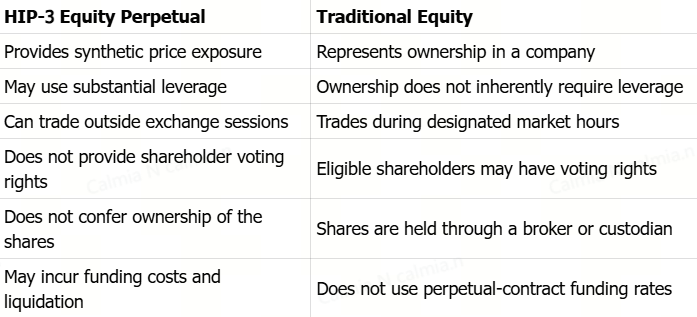
Hyperliquid’s expansion into equities should consequently be described as broader access to equity-price exposure, not the transfer of securities ownership onto the platform.
Why Traditional-Asset Exposure Is Attracting Traders
Round-the-clock accessibility is one of the clearest sources of demand. Traditional securities markets operate through fixed sessions, regional time zones, weekends, and public holidays, while corporate announcements, geopolitical events, and monetary-policy decisions can emerge after the underlying market closes. On-chain perpetuals allow traders to adjust directional exposure during these periods rather than waiting for the next official session. This can be particularly useful for globally distributed and event-driven participants reacting to earnings, policy announcements, or changes in market sentiment.
Unified collateral and account infrastructure provide another advantage. A participant seeking exposure to cryptocurrencies, technology stocks, indices, and commodities would ordinarily need to maintain separate relationships with crypto exchanges, securities brokers, and futures providers. Hyperliquid places several categories of exposure within a common trading environment, reducing some of the operational friction involved in transferring capital between venues. This structure does not eliminate leverage risk, but it simplifies the interface through which multiple positions can be opened and managed.
The composition of HIP-3 activity also points to thematic demand. The S&P 500-linked market provides broad exposure to U.S. equity risk, while SK Hynix and Micron contracts reflect interest in AI infrastructure, semiconductors, and memory-chip markets. Crypto-native traders increasingly monitor many of the same themes that influence conventional portfolios, including interest-rate expectations, data-center investment, chip demand, and corporate earnings. Perpetual contracts allow these participants to express short-term long or short views without opening traditional brokerage accounts.
HIP-3 also changes how this demand can be commercialized. Third-party deployers can identify an underserved theme, introduce a corresponding market, and receive a portion of its trading fees. This may help Hyperliquid respond quickly to new narratives, but it could also generate fragmented liquidity and thinly traded contracts. The model will create lasting value only if competition among deployers improves market quality rather than merely increasing the number of available symbols.
Can Hyperliquid Become a Global On-Chain Derivatives Layer?
Competition among decentralized derivatives platforms is broadening. Earlier competition focused primarily on transaction fees, execution speed, order-book performance, and liquidity in BTC, ETH, and other crypto assets. As HIP-3 grows, platforms must also compete in external asset coverage, oracle resilience, capital efficiency, and the ability to manage complex liquidations during extreme market conditions. If non-crypto open interest continues to expand, Hyperliquid may increasingly overlap with contracts-for-difference providers, retail foreign-exchange brokers, and online derivatives venues rather than competing only with centralized crypto exchanges.
This development does not make Hyperliquid an “on-chain Nasdaq.” Nasdaq operates a regulated securities market involving issuer disclosures, securities registration, shareholder rights, corporate actions, investor protection, and market surveillance. HIP-3 primarily facilitates synthetic exposure through perpetual contracts, creating fundamentally different legal rights and responsibilities. A more accurate description is that Hyperliquid is developing into a multi-asset on-chain synthetic derivatives platform.
Such a platform could become an important price-discovery and risk-transfer venue, especially for assets without continuous global trading access. However, that position requires infrastructure capable of operating when traditional markets are closed, reference prices become uncertain, market makers reduce exposure, or correlated positions are liquidated simultaneously. High open interest demonstrates demand; durable market structure is proven under stress.
Three Constraints on Further Expansion
Regulation is the first constraint. Leveraged contracts linked to equities and stock indices may fall under securities-derivatives, futures, contracts-for-difference, or cross-border financial-services rules, depending on their structure and jurisdiction. Third-party deployment does not automatically remove these obligations. Regulators may examine the respective roles of protocol developers, interface operators, deployers, oracle providers, market makers, and administrators, particularly when products are accessible to retail users.
The second constraint is the mismatch between continuous on-chain trading and limited cash-market hours. When an equity perpetual trades while the underlying exchange is closed, direct arbitrage against the stock may be unavailable. Pricing may depend more heavily on futures, exchange-traded funds, related securities, macroeconomic expectations, and available on-chain liquidity. Spreads may widen, and the contract can diverge from the price later established when the cash market reopens. A sudden reference-price adjustment may then trigger liquidations among highly leveraged positions.
The third constraint is leverage and liquidity concentration. Higher open interest increases the demands placed on oracle continuity, market-making capacity, collateral systems, insurance mechanisms, and liquidation engines. If liquidity depends on a small number of market makers, order withdrawals during volatility may sharply increase slippage and liquidation losses. Longer-term holders must also manage recurring funding payments and basis fluctuations in addition to the directional performance of the underlying asset.
Conclusion
Hyperliquid’s approximately $11.5 billion in open interest, including nearly $4 billion from HIP-3 markets, shows that on-chain perpetuals are expanding into equity indices, technology shares, and commodities. The development broadens Hyperliquid’s addressable market, but it does not turn synthetic contracts into securities ownership or convert open interest into platform assets. Whether this expansion becomes durable will depend on reliable pricing, sustainable liquidity, resilient liquidation systems, and regulatory frameworks capable of supporting multi-asset derivatives across jurisdictions.


You May Also Like

Mainz vs Union Berlin: 2026 Bundesliga Match Prediction and Analysis

Hyperliquid Responds to Trade.xyz SK Hynix Pricing Error: What HIP-3 Traders Should Learn

How Is the World Cup Golden Glove Winner Chosen? Rules, Criteria and Common Misunderstandings