Bitcoin developer Peter Todd has pushed back against calls to bring Zcash-style privacy into Bitcoin’s consensus layer, arguing that the cryptographic risk profileBitcoin developer Peter Todd has pushed back against calls to bring Zcash-style privacy into Bitcoin’s consensus layer, arguing that the cryptographic risk profile

Peter Todd Warns Zcash Tech Is Too Risky For Bitcoin Privacy Push

2026/06/05 08:30
3 min read
For feedback or concerns regarding this content, please contact us at crypto.news@mexc.com

Bitcoin developer Peter Todd has pushed back against calls to bring Zcash-style privacy into Bitcoin’s consensus layer, arguing that the cryptographic risk profile is too high for the network’s base protocol. The debate erupted after ZODL developers disclosed an issue affecting the Orchard shielded pool, briefly turning a technical incident into a broader argument over privacy, auditability, and Bitcoin ossification.

Todd’s initial post was direct: “Why adding Zcash style privacy to Bitcoin at the consensus layer is a bad idea.” He was responding to a post from Zcash Open Development Lab, which said a “coordinated Zcash network upgrade” was underway after an issue affecting the Zcash Orchard pool was identified during routine auditing and security review processes.

Why Peter Todd Sounds Alarm On Zcash-Style Privacy

The exchange quickly widened beyond ZEC itself. One user argued that Bitcoin has its own history of critical bugs, pointing to the 2010 value overflow incident and the 2013 chain split as evidence that “no protocol is exempt from tech issues.” The same post accused Bitcoin maximalists of pushing for “total ossification” while facing future threats such as quantum computing.

Todd answered by drawing a distinction between visible and hidden failures. “Exactly my point. With Bitcoin, rolling back the chain is feasible, as only a small subset of coins were affected, and the exploit was trivial to notice,” he wrote. His argument was not that Bitcoin is bug-free, but that its accounting model makes certain classes of catastrophic bugs easier to detect and unwind.

That point became the core of the disagreement. When another user argued that rejecting consensus-layer privacy on bug-risk grounds would “stop any innovation/development,” Todd responded that not all cryptography carries the same operational risk. “Different types of cryptography have different levels of risk to them. Zcash-style cryptography has a very high level of risk, much more so than Bitcoin’s cryptography. Which is reflected in how Zcash has had much more serious issues than Bitcoin.”

The counterargument was that Bitcoin itself has suffered serious early failures. One participant cited the 2010 value overflow incident and the 2018 bug, CVE-2018-17144, as examples that challenged Todd’s framing. Todd rejected the comparison, saying neither case put the currency at the same kind of existential risk.

“Neither of those exploits had any chance of destroying the currency,” Todd wrote. “Exactly what coins were counterfeit was trivially visible, allowing easy rollbacks. Not so with Zcash.”

The disagreement turns on a specific property of shielded systems: privacy can reduce the visibility that makes supply audits straightforward. In Todd’s view, this changes the risk calculation for Bitcoin. A bug in transparent accounting can be noticed because invalid outputs or counterfeit coins are visible on-chain. In a deeply shielded system, he argued, the damage may be harder to observe, harder to attribute, and harder to reverse.

Zcash defenders pushed back on that framing as well. One user told Todd that he did not understand the “turnstile construct,” arguing that “no such bug can affect the total ZEC supply.” Todd shifted the focus from total supply to shielded user balances, noting that a large share of ZEC already sits inside the shielded pool. “30% of the Zcash supply is shielded. That supply being destroyed would be a disaster, and would completely wipe out the holdings of a high % of all Zcash users. I personally have a little bit of Zcash, all of which is shielded.”

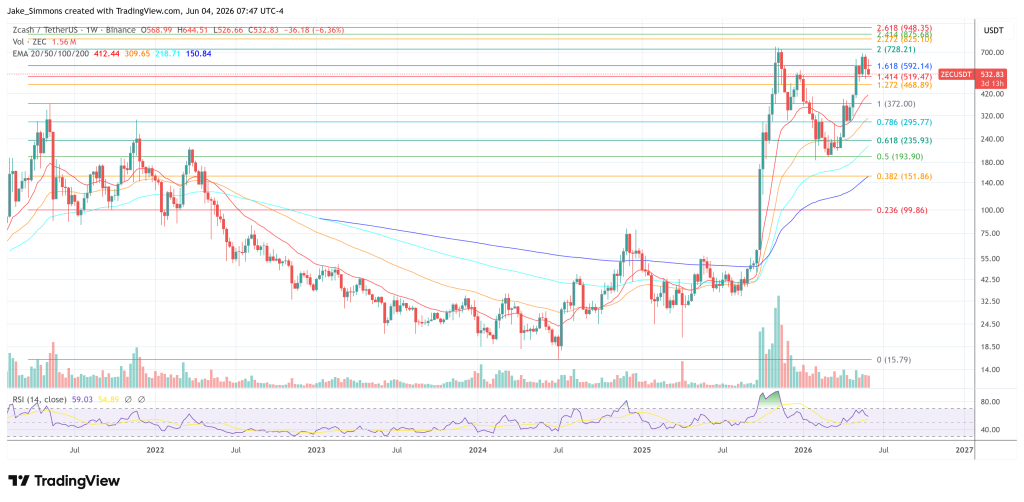
At press time, ZEC traded at $532.
Zcash price
Market Opportunity
Solayer Logo
Solayer Price(LAYER)
$0.06623
$0.06623$0.06623
-7.84%
USD
Solayer (LAYER) Live Price Chart

SPACEX(PRE) Launchpad

SPACEX(PRE) LaunchpadSPACEX(PRE) Launchpad

Register for a chance to win a free lucky draw

Disclaimer: The articles reposted on this site are sourced from public platforms and are provided for informational purposes only. They do not necessarily reflect the views of MEXC. All rights remain with the original authors. If you believe any content infringes on third-party rights, please contact crypto.news@mexc.com for removal. MEXC makes no guarantees regarding the accuracy, completeness, or timeliness of the content and is not responsible for any actions taken based on the information provided. The content does not constitute financial, legal, or other professional advice, nor should it be considered a recommendation or endorsement by MEXC.

You May Also Like

UK crypto holders brace for FCA’s expanded regulatory reach

UK crypto holders brace for FCA’s expanded regulatory reach

The post UK crypto holders brace for FCA’s expanded regulatory reach appeared on BitcoinEthereumNews.com. British crypto holders may soon face a very different landscape as the Financial Conduct Authority (FCA) moves to expand its regulatory reach in the industry. A new consultation paper outlines how the watchdog intends to apply its rulebook to crypto firms, shaping everything from asset safeguarding to trading platform operation. According to the financial regulator, these proposals would translate into clearer protections for retail investors and stricter oversight of crypto firms. UK FCA plans Until now, UK crypto users mostly encountered the FCA through rules on promotions and anti-money laundering checks. The consultation paper goes much further. It proposes direct oversight of stablecoin issuers, custodians, and crypto-asset trading platforms (CATPs). For investors, that means the wallets, exchanges, and coins they rely on could soon be subject to the same governance and resilience standards as traditional financial institutions. The regulator has also clarified that firms need official authorization before serving customers. This condition should, in theory, reduce the risk of sudden platform failures or unclear accountability. David Geale, the FCA’s executive director of payments and digital finance, said the proposals are designed to strike a balance between innovation and protection. He explained: “We want to develop a sustainable and competitive crypto sector – balancing innovation, market integrity and trust.” Geale noted that while the rules will not eliminate investment risks, they will create consistent standards, helping consumers understand what to expect from registered firms. Why does this matter for crypto holders? The UK regulatory framework shift would provide safer custody of assets, better disclosure of risks, and clearer recourse if something goes wrong. However, the regulator was also frank in its submission, arguing that no rulebook can eliminate the volatility or inherent risks of holding digital assets. Instead, the focus is on ensuring that when consumers choose to invest, they do…
Share
BitcoinEthereumNews2025/09/17 23:52
Bitcoin & Ethereum Inflows Hit 1-Year Low as Crypto Investors Brace for Fed Decision – BTC Eyes $120K

Bitcoin & Ethereum Inflows Hit 1-Year Low as Crypto Investors Brace for Fed Decision – BTC Eyes $120K

Bitcoin and Ethereum exchange inflows have dropped to a 1-year low indicating reduced selling pressure and investor reluctance to exit positions ahead of a potential U.S. Federal Reserve rate cut, with on-chain data revealing exchange inflows falling to a 7-day moving average of 25K BTC from 51K BTC in July.
Share
Coinstats2025/09/17 23:29
Solana (SOL), Dogecoin (DOGE), or Little Pepe (LILPEPE): Here’s Which Coin May Deliver $10,000 in Q4 if You Invest $1,000 Right Now


Solana (SOL), Dogecoin (DOGE), or Little Pepe (LILPEPE): Here’s Which Coin May Deliver $10,000 in Q4 if You Invest $1,000 Right Now

Meme coins and blockchain projects continue to shape the digital asset market, with Dogecoin (DOGE), Solana (SOL), and the rising Little Pepe (LILPEPE) drawing strong investor attention. Each coin has a unique value proposition, yet data suggests one may stand out in Q4 as the most likely candidate to turn a modest $1,000 investment into […]
Share
Cryptopolitan2025/09/18 00:01

RealStocks Now Live

RealStocks Now LiveRealStocks Now Live

Trade real U.S. stock via regulated brokerage


